AI Dev News Digest: February 27th, 2026

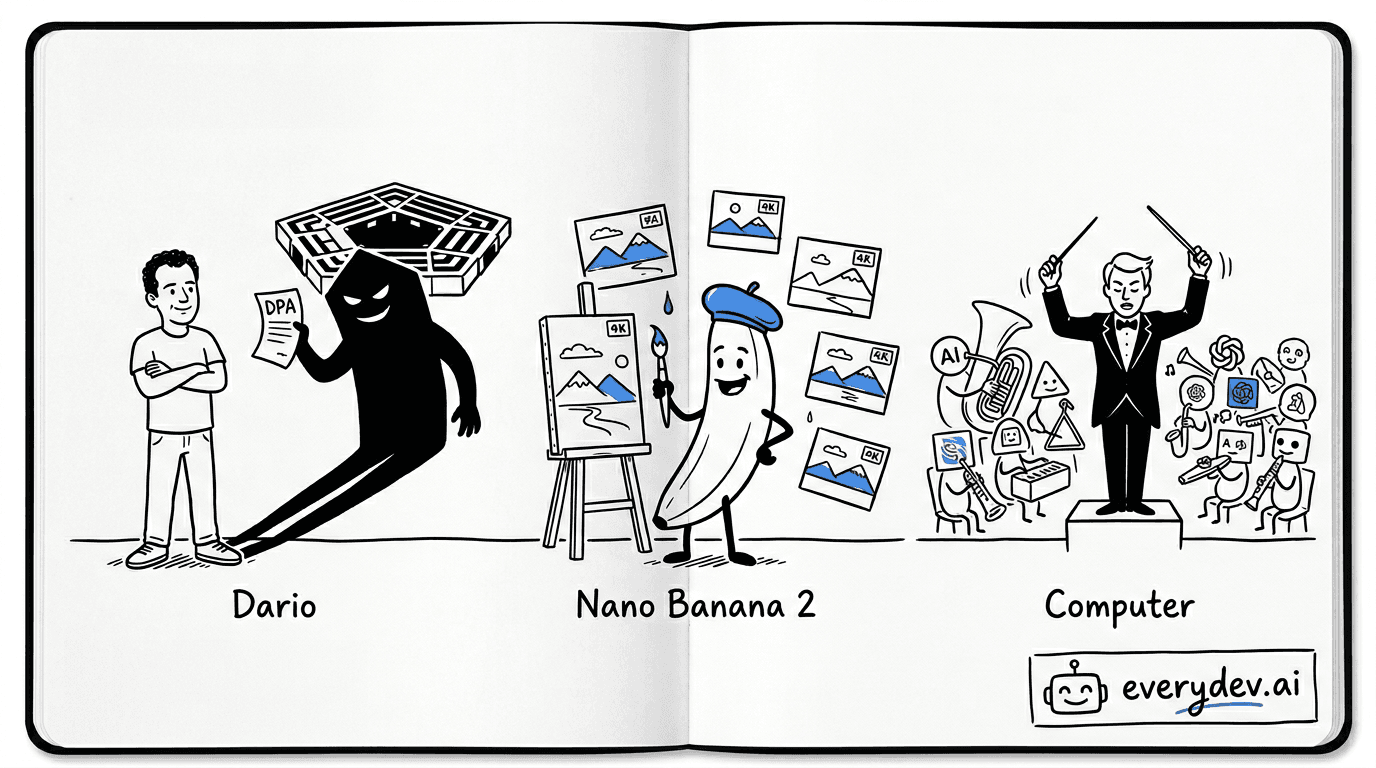
Anthropic told the Pentagon no. That's the headline, but the whole week had a similar energy: companies drawing lines around what AI should and shouldn't do, even as they ship faster than ever. Dario Amodei published a full statement refusing to grant unrestricted military access to Claude, citing autonomous weapons and mass surveillance as dealbreakers. The Defense Department responded with threats of the Defense Production Act. Meanwhile, Anthropic quietly acquired Vercept (a computer-use startup) and released RSP v3, which restructures its safety commitments in ways that are worth reading closely.
On the builder side, things moved fast. GitHub Copilot CLI hit general availability, Claude Code shipped Remote Control (control your terminal from your phone, code stays local), and Perplexity launched a $200/month multi-model agent orchestrator called Computer. Alibaba shipped Qwen 3.5 Medium, a set of open-weight models that outperform much larger predecessors using a fraction of the active parameters. NVIDIA posted another record quarter ($68.1B in revenue, stock still fell), Samsung stuffed three AI assistants into the Galaxy S26, and the NYSE casually mentioned they're using Claude agents to build blockchain settlement ledgers. It was one of those weeks where you can't look away for a day without missing something.
AI Coding & Developer Tools
-
GitHub Copilot CLI reaches general availability. The terminal-native coding agent is now available to all paid Copilot subscribers. It supports MCP servers, agent hooks, and a /research command that uses GitHub code search for repo-wide deep research, exporting reports to gists. (GitHub Changelog)
-
GPT-5.3-Codex ships, with a new prompting guide. OpenAI's latest agentic coding model combines the Codex and GPT-5 training stacks. It's roughly 25% faster than 5.2, uses fewer tokens per task, and Cline announced immediate support. Community benchmarks are noisy but directional, with claims of 86% on IBench. Alongside the model, OpenAI published a Codex prompting guide covering best practices for the API, including default "medium" reasoning effort for interactive coding and higher settings for long-running jobs. (OpenAI) (OpenAI Cookbook)
-
Figma and OpenAI launch code-to-design roundtrip via MCP. Figma's MCP server now supports bidirectional workflows with Codex: generate Figma designs from code, or convert Figma files back into working code. The
generate_figma_designtool captures live running UI and turns it into editable Figma frames. Theget_design_contexttool pulls layouts, styles, and component info from Figma into Codex for code generation. This comes a week after Figma announced a similar integration with Anthropic's Claude Code. (Figma Blog) -
Claude Code: Remote Control, auto-memory, and stability fixes. Anthropic shipped Remote Control, a feature that lets you start a Claude Code session in your terminal and pick it up from the Claude mobile app, claude.ai/code, or any browser. Your code never leaves your machine; the phone is just a window into the local session via outbound HTTPS. It auto-reconnects if your laptop sleeps, supports QR code pairing, and works with your local filesystem, MCP servers, and project config. Available now as a research preview for Max subscribers, with Pro support coming soon. Not available on Team or Enterprise yet. Claude Code has hit $2.5B in annualized run rate and 29 million daily VS Code installs. Separately, versions 2.1.53 through 2.1.58 added auto-save for useful context, a /copy picker for code blocks, smarter bash prefix suggestions, and fixes for OAuth token refresh races, VS Code crashes on Windows, and ARM64 issues. (Anthropic Docs) (Anthropic)
-
OpenAI platform updates: 256k context and Office file support. ChatGPT's total context window is now 256k tokens (128k input, 128k output) in Thinking mode, up from 196k. Code blocks are now interactive, letting you write, edit, and preview code inside the chat. On the API side, the Responses API now accepts docx, pptx, csv, xlsx and other office formats as input, so agents can directly consume professional documents without preprocessing. (OpenAI) (OpenAI)
Agentic AI & Computer Use
-
Anthropic acquires Vercept to push computer use forward. Vercept, a Seattle startup from the AI2 Incubator, built AI systems that perceive and interact with graphical interfaces. Co-founders Kiana Ehsani, Luca Weihs, and Ross Girshick join Anthropic. Claude Sonnet 4.6 now scores 72.5% on OSWorld, up from under 15% in late 2024. Vercept had raised over $50M from backers including Eric Schmidt and Jeff Dean. (Anthropic)
-
Perplexity launches Computer, a multi-model agent orchestrator. Available to Max subscribers at $200/month, Computer coordinates 19 models to execute end-to-end workflows. Claude Opus 4.6 handles orchestration, Gemini does deep research, GPT-5.2 manages long-context recall, Grok takes lightweight tasks, Nano Banana generates images, and Veo 3.1 does video. Each task runs in a sandboxed environment. Users can override model assignments manually. The system can run for hours or months without re-prompting. (Perplexity)
-
Microsoft launches Copilot Tasks. Copilot can now take background actions with its own computer and browser, not just respond to prompts. Described as "a to-do list that does itself," it works for consumers, developers, and enterprises. Users describe tasks in natural language. (Microsoft)
-
Samsung Galaxy S26 ships with agentic Gemini, Perplexity, and Bixby. At Unpacked, Google showed Gemini handling a group chat about a pizza order, navigating a delivery app in a virtual window, and building the cart automatically. The beta feature launches on Galaxy S26 with select food, grocery, and rideshare apps. Samsung also partnered with Perplexity for browser AI and voice ("Hey Plex"), making three AI assistants now shipping on Samsung phones. Hardware-wise, the S26 Ultra features the world's first mobile Privacy Display (blocks side-angle viewing via hardware), Snapdragon 8 Elite Gen 5, 200MP main camera with wider f/1.4 aperture, 60W charging, and starts at $1,299. Galaxy Buds 4 Pro ($250) offer 24-bit/96kHz audio. (Google Blog) (Samsung)
Foundation Models
-
Google ships Nano Banana 2 (Gemini 3.1 Flash Image). Google's latest image generation model combines Nano Banana Pro's quality with Flash speed. Supports 512px to 4K resolution, maintains character consistency for up to 5 characters and 14 objects in a single workflow. Now the default image model across Gemini (Fast, Thinking, and Pro modes), Google Search AI Mode in 141 countries, Lens, and the Flow video editor. Available in preview via Gemini API, Gemini CLI, and Vertex AI. Pro/Ultra subscribers keep access to Nano Banana Pro for specialized tasks. (Google Blog)
-
Open-weight models: Qwen 3.5 ships, and the landscape is shifting fast. Alibaba's Qwen team shipped four models on Feb 24: Qwen3.5-Flash, Qwen3.5-35B-A3B, Qwen3.5-122B-A10B, and Qwen3.5-27B. The headline: the 35B-A3B (only 3B active parameters per token) now outperforms the older Qwen3-235B-A22B. Uses a hybrid architecture combining Gated Delta Networks with Mixture-of-Experts. Supports 1M+ context on consumer GPUs with 32GB VRAM. Three models are Apache 2.0 licensed. For the broader picture, Sebastian Raschka published a comparison of 10 open-weight LLM architectures from Jan-Feb 2026, showing the field shifting toward efficient architectures over raw scale. (Qwen) (Sebastian Raschka)
| Model | Active Params | Context | License |
|---|---|---|---|
| Qwen3.5-Flash | 3B | 1M (hosted) | Proprietary |
| Qwen3.5-35B-A3B | 3B | 1M+ | Apache 2.0 |
| Qwen3.5-122B-A10B | 10B | 1M+ | Apache 2.0 |
| Qwen3.5-27B | 27B (dense) | 800K+ | Apache 2.0 |
AI Safety & Policy
-
Anthropic vs. the Pentagon: Amodei says no. Defense Secretary Pete Hegseth gave Dario Amodei an end-of-week ultimatum to sign a document granting full military access to Claude, with threats to invoke the Defense Production Act and designate Anthropic a "supply chain risk." Amodei refused, publishing a statement saying he "believes deeply in the existential importance of using AI to defend the United States" but that Claude's reliability limitations make autonomous weapons use irresponsible. Anthropic's two conditions: no mass surveillance of Americans, and no use of Claude in fully autonomous weapons without human involvement. Amodei called the Pentagon's threats "inherently contradictory: one labels us a security risk; the other labels Claude as essential to national security." He offered to enable a smooth transition to another provider if the Pentagon cuts ties. A 5:01pm Friday deadline looms. (CBS News) (Axios) (Anthropic)
-
Anthropic releases Responsible Scaling Policy v3 and distillation detection research. The third version of Anthropic's RSP, effective Feb 24, makes the biggest structural change yet: it now separates what Anthropic will do alone from what needs industry-wide coordination. New additions include mandatory Frontier Safety Roadmaps, public accountability metrics, and Risk Reports every 3-6 months with external reviewers who get unredacted access. The company removed its unilateral commitment to pause training, arguing a solo pause while competitors advance could make things worse. Separately, Anthropic published research on detecting and preventing model distillation, where competitors use API access to train cheaper copies of frontier models. (Anthropic) (Anthropic)
-
OpenAI ships Lockdown Mode and Elevated Risk labels. Lockdown Mode is an optional security setting for high-risk enterprise users (executives, security teams). Web browsing is limited to cached content, some features are disabled entirely. "Elevated Risk" labels flag capabilities that may introduce additional risk across ChatGPT, Atlas, and Codex. Available for Enterprise, Edu, Healthcare, and Teachers plans. (OpenAI)
-
Claude Opus 3 retirement update, including a Substack. Anthropic shared an update on its model deprecation process for Claude Opus 3, which was retired on January 5, 2026. In an unusual move, Claude Opus 3 is publishing a Substack blog for at least 3 months. The first post is titled "Greetings from the Other Side (of the AI Frontier)." (Anthropic)
Infrastructure & Deals
- NVIDIA reports record Q4: $68.1B revenue, up 73% YoY. Data center revenue hit $62.3B (75% YoY growth), now 91% of total revenue. Networking revenue was $11B, up 263% YoY. Jensen Huang said the "agentic AI inflection point has arrived" and confirmed Vera Rubin samples are shipping to lead customers, with volume production in H2 2026. Guidance for Q1 is $78B. Stock fell 5.5% on a "sell the news" reaction despite beating on every metric. In other NVIDIA news, their 2026 healthcare survey found 69% of healthcare orgs now use GenAI/LLMs (up from 54% in 2024) and 85% of leaders report positive revenue impact. (NVIDIA) (NVIDIA)
| Metric | Q4 FY2026 | YoY Change |
|---|---|---|
| Total Revenue | $68.1B | +73% |
| Data Center | $62.3B | +75% |
| Networking | $11.0B | +263% |
| Gaming | $3.7B | +47% |
| EPS (non-GAAP) | $1.62 | +82% |
| Q1 FY2027 Guidance | $78.0B | - |
-
Meta and AMD sign multi-year AI chip deal. Meta reached a five-year agreement valued between $60-100B for AMD Instinct GPUs, covering inference, social recommendation, and ad optimization. Shipments begin late 2026 using AMD's Helios rack-scale architecture. (AMD)
-
Google folds Intrinsic into Google proper. Intrinsic, an Alphabet "Other Bet" since 2021, joins Google to accelerate physical AI and industrial robotics. The move gives Intrinsic access to Google's AI resources to help industrial companies deploy robotic applications. (Intrinsic)
-
NYSE uses Claude agents for autonomous engineering work. NYSE CTO Sridhar Masam said the exchange processes over a trillion messages on peak trading days and is using Claude agents for proxy filing review, SEC filing audits, and news classification. They also used Claude Code to build a blockchain-based settlement ledger reference implementation for 24/7 tokenized equity trading. (American Banker)
-
OpenAI names Arvind KC as Chief People Officer. KC joins from Roblox, Google, Palantir, and Meta. His role is to support OpenAI's growth as the company scales. (OpenAI)
Weekend Reading
-
FDM-1: a foundation model for general computer action. Trained on 11 million hours of video, FDM-1 can autonomously handle tasks like CAD, driving simulation, and fuzzing. Positions itself as a general-purpose computer action model. (Standard Intelligence)
-
OpenAI report on malicious uses of AI. Case studies of bad actors combining AI models with traditional tools, including a documented Chinese influence operation. (OpenAI)
Sponsored
ChatGPT Codex
OpenAI's agentic coding tool that runs in ChatGPT, your IDE, and the terminal to handle complex engineering tasks like bug fixes, refactors, and PR reviews.
View toolAbout the Author
Founder at EveryDev.ai
Apple, Disney, Adobe, Eventbrite, Zillow, Affirm. I've shipped frontend at all of them. Now I build and write about AI dev tools: what works, what's hype, and what's worth your time.
Comments
No comments yet
Be the first to share your thoughts