
Issue #15 · Weekly Digest
Weekly AI Dev News Digest: April 6 - 10, 2026
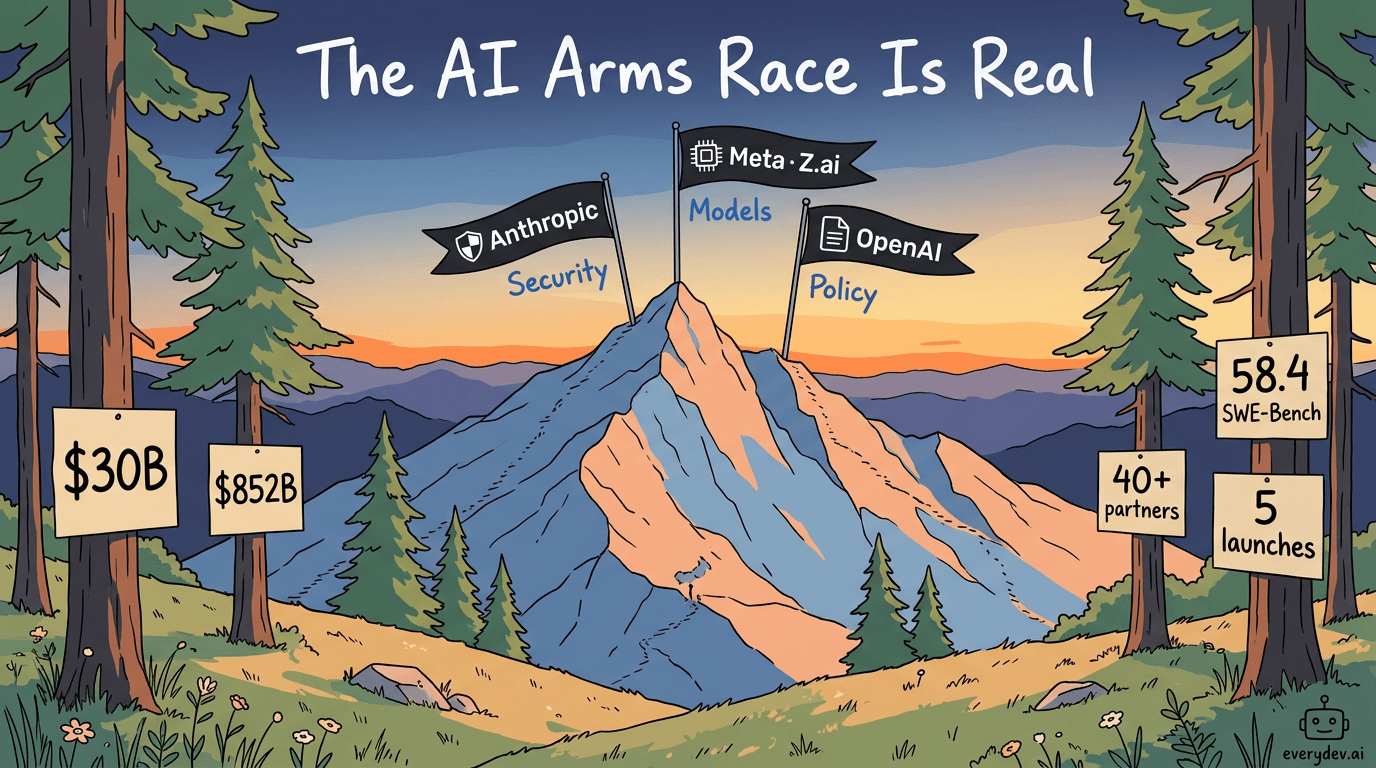
Anthropic shipped five products in five days, including a model it says is too dangerous to release. Everyone else responded with policy papers, proprietary pivots, and open-source counterattacks. The AI arms race stopped being a metaphor.
Anthropic came into the week with something to prove. After last week's source code leak and DMCA debacle, the company launched Project Glasswing, Managed Agents, the Advisor Tool, Cowork for Enterprise, and a new Claude Code capability in rapid succession. The centerpiece: Claude Mythos Preview, a model Anthropic says autonomously discovered thousands of zero-day vulnerabilities across every major OS and browser without human involvement. Instead of releasing it, they locked it behind a security initiative with 40+ partners. It was either the most responsible thing an AI lab has done or the most dramatic product marketing, and possibly both.
The rest of the industry wasn't standing still. Meta shipped its first proprietary model from a lab run by ex-Scale AI CEO Alexandr Wang. Z.ai open-sourced GLM-5.1, which topped SWE-Bench Pro and was trained entirely on Huawei chips with no NVIDIA hardware. OpenAI published a policy paper calling for robot taxes on its own technology. Google merged NotebookLM into Gemini, turning research into a persistent layer inside its AI app. The model race is now an infrastructure race, a policy race, and a geopolitics race, all running at once.
$30B
Anthropic revenue run rate
40+
Glasswing partners
1,000+
businesses spending $1M+ annually
58.4
SWE-Bench Pro (GLM-5.1, open-source leader)
$115-135B
Meta AI capex guidance
In Focus
Anthropic's Five-Day Sprint
Anthropic announced Claude Mythos Preview, described it as "too capable for public release," and immediately put it to work. Project Glasswing is a cybersecurity defense initiative where the model autonomously discovered thousands of zero-day vulnerabilities across every major operating system and browser, including a 17-year-old FreeBSD RCE it found and exploited without human involvement (CVE-2026-4747). Over 40 partners are involved, including AWS, Apple, Google, Microsoft, NVIDIA, CrowdStrike, and JPMorganChase. Anthropic is backing it with $100M in usage credits and $4M to open-source security orgs. (Anthropic) (Red Team Blog)
The same week, Anthropic shipped Claude Managed Agents into public beta: composable APIs for building and deploying cloud-hosted agents at scale, with sandboxed code execution, checkpointing, credential management, scoped permissions, and end-to-end tracing. Pricing is $0.08/session-hour plus standard token rates. Notion, Rakuten, and Sentry are early adopters. Sentry paired its debugging agent with a Claude agent that writes patches and opens PRs. (Anthropic)
Then came the Advisor Tool, a new API feature that lets Sonnet or Haiku run as the executor while Opus serves as an on-demand advisor. Sonnet only consults Opus when it hits a decision it can't handle, then resumes on its own. In evaluations, Sonnet+Advisor scored 2.7 points higher on SWE-bench Multilingual than Sonnet alone while costing 11.9% less per task. Haiku+Advisor doubled its BrowseComp score at 85% less than Sonnet's cost. One-line API change to enable it. (Anthropic)
Enterprise and Developer Tools
Claude Cowork exited research preview and went GA on all paid plans with six enterprise features: RBAC via SCIM, group spend limits, usage analytics, expanded OpenTelemetry support for SIEM pipelines, per-connector tool controls, and a new Zoom MCP connector. Anthropic noted that the majority of Cowork usage comes from outside engineering, with ops, marketing, finance, and legal teams driving adoption. (Anthropic)
Claude Code added a Monitor tool for background event watching, dispatching scripts that watch for specific events (log errors, PR updates, test failures) and wake the agent only when something needs attention. This replaces token-heavy polling loops in agent workflows. (Noah Zweben on X)
And the revenue numbers suggest the market is listening regardless. Anthropic's run rate hit $30B, up from $9B at the end of 2025. The company expanded its compute agreement with Google and Broadcom and now serves over 1,000 business customers spending more than $1M annually. (Anthropic)
In Focus
The Model Race Goes Global
Meta shipped Muse Spark, its first model from Meta Superintelligence Labs, code-named Avocado and led by former Scale AI CEO Alexandr Wang. This is Meta's first proprietary (not open-source) frontier model. It scores 52 on the Artificial Analysis Intelligence Index, behind Gemini 3.1 Pro, GPT-5.4, and Claude Opus 4.6 but ahead of Claude Sonnet 4.6 and GLM-5.1. It features a parallel sub-agent "Contemplating" mode, strong multimodal perception (second-best vision model benchmarked), and health reasoning trained with 1,000+ physicians. No public API yet, but Meta plans paid access. Meta's AI capex guidance for 2026 is $115-135B, nearly double last year. (Meta AI) (CNBC) (Artificial Analysis)
The more consequential model release came from China. Z.ai (formerly Zhipu AI) open-sourced GLM-5.1 under an MIT license. It scores 58.4 on SWE-Bench Pro, edging out GPT-5.4 (57.7) and Claude Opus 4.6 (57.3), making it the first open-source model to lead a major coding benchmark. The 744B MoE model (40B active params) can work autonomously on a single coding task for up to 8 hours. API pricing is $1.00/M input, $3.20/M output. Z.ai went public in Hong Kong in January at a ~$31B valuation. (CnTechPost)
GLM-5.1 was trained entirely on Huawei Ascend chips with no NVIDIA hardware. That's a working proof that the Chinese AI ecosystem can produce frontier-competitive models without access to US semiconductor exports. Whether you view that as a trade policy failure or a market inevitability depends on your politics, but it's a technical fact now, not speculation.
In Focus
OpenAI Turns to Policy
OpenAI published "Industrial Policy for the Intelligence Age," a 13-page paper proposing a public wealth fund giving citizens a stake in AI-driven growth, taxes on automated labor, subsidized four-day workweek pilots at full pay, auto-triggering safety nets tied to real-time displacement data, and containment playbooks for autonomous AI systems that can self-replicate. An $852B company calling for robot taxes on its own technology is, at minimum, a signal about how seriously the industry views disruption. (OpenAI)
Separately, OpenAI launched a Safety Fellowship funding external researchers from September 2026 through February 2027, with grants up to $100K and $1M in API credits. The Child Safety Blueprint (developed with NCMEC and the Attorney General Alliance) proposes modernizing CSAM laws to cover AI-generated material, improving reporting pipelines, and embedding safeguards directly in AI systems. (OpenAI Child Safety)
On the product side, OpenAI is retiring six older Codex models on April 14, including gpt-5, gpt-5.1, and gpt-5.2-codex variants. Models being kept: gpt-5.4, gpt-5.4-mini, gpt-5.3-codex, and gpt-5.2. (OpenAI Developers)
Signals
Signals from the Edges
Google merges NotebookLM into Gemini
You can now create notebooks inside the Gemini app that sync bi-directionally with NotebookLM. Past chats fold into notebooks as persistent context, and sources added in either app appear in both. It's ChatGPT Projects but with NotebookLM's research tools (video overviews, infographics) built in. Rolling out to AI Ultra, Pro, and Plus subscribers on web.
Intel joins Elon Musk's Terafab AI chip project
Intel will partner with SpaceX and Tesla on Musk's Terafab initiative, targeting 1 terawatt/year of compute for robotics and data center infrastructure. Intel stock jumped over 2% on the news. Foundry capability is becoming a geopolitical asset again.
NVIDIA pushes physical AI during National Robotics Week
NVIDIA released RoboLab, a simulation benchmark built on Isaac and Omniverse for training robot policies. Toyota Research Institute is using Cosmos world foundation models for robot training. Aigen's agricultural rovers use Jetson Orin modules for real-time weed detection, letting farmers grow crops without herbicides.
Nous Research partners with Xiaomi on MiMo V2 Pro
The model is now available on Hermes Agent via the Nous Portal, free for two weeks.
New York will require AI disclosures in ads starting June 2026
One of the first state-level AI transparency requirements for advertising. Details are still emerging.
AGI timeline forecasts shift earlier
Daniel Kokotajlo and Eli Lifland updated their AI 2027 forecasts. Daniel's AGI median moved from 2030 to 2029, with his probability of AGI by end of 2027 jumping from 15% to 25%. The row most relevant to developers: "Superhuman Coder" (30x agent-to-engineer productivity). Daniel says 2029. Eli says 2032.
Looking Ahead
What to Watch
- 1
Glasswing delivery
Anthropic promised autonomous vulnerability discovery at scale. The 40+ partner list is impressive, but the proof is in disclosed CVEs and patched systems over the next quarter, not in the launch announcement.
- 2
Meta's proprietary pivot
Muse Spark is Meta's first closed model. If it gets an API, Meta enters direct competition with OpenAI and Anthropic for enterprise spend. Watch for pricing signals.
- 3
Chinese chip independence
GLM-5.1 on Huawei Ascend is a single data point. If more frontier models follow on non-NVIDIA hardware, the US export control strategy needs rethinking.
- 4
OpenAI model deprecations
Six Codex models go dark April 14. If you're still on gpt-5 or gpt-5.1 variants, migration is urgent.
- 5
AI ad regulation
New York's disclosure requirement could become a template. Watch for California and EU follow-ons.