Clanker Cloud
A local-first AI desktop workspace for shipping, debugging, and operating cloud and Kubernetes infrastructure with review-first execution and bring-your-own AI keys.
At a Glance
About Clanker Cloud
Clanker Cloud is a desktop AI workspace built by Nov 1337 Labs that lets engineers and AI agents query, plan, and operate cloud infrastructure without routing credentials through a hosted SaaS layer. It is built on top of the open-source Clanker CLI (MIT-licensed, written in Go) and is currently in free beta through July 2026. The product targets builders shipping AI-built apps, lean DevOps and SRE teams, and AI researchers who want local-first control over multi-cloud environments.
What It Is
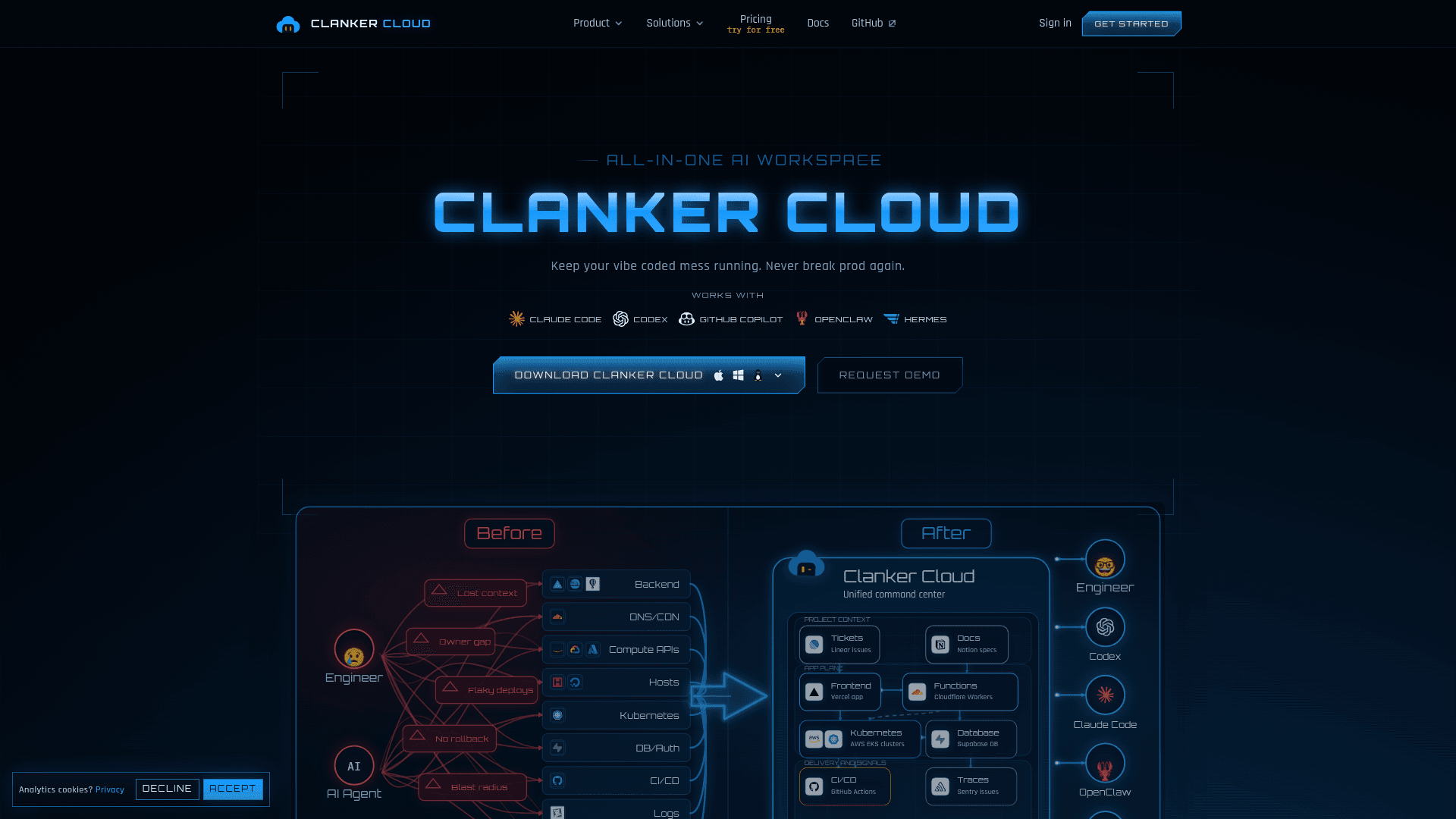
Clanker Cloud is a local-first AI DevOps workspace that connects to existing cloud accounts — AWS, GCP, Azure, Tencent Cloud, Kubernetes, Cloudflare, Hetzner, DigitalOcean, Vercel, Supabase, Railway, Fly.io, and Verda — and lets users ask plain-English questions about live infrastructure, generate reviewed execution plans, and optionally apply changes in an explicit "maker mode." Credentials and AI keys stay on the user's machine rather than passing through a vendor-hosted backend. The underlying Clanker CLI is open source under the MIT license and powers the terminal, automation, MCP, and desktop app workflows.
Architecture: Local-First with Agent-Native Design
The product is structured around a clear trust boundary: cloud credentials and AI provider keys never leave the local machine. Users bring their own model keys (OpenAI, Anthropic, Google Gemini, Cohere, Mistral, Ollama, llama.cpp, and others), so AI inference costs are billed directly by the chosen provider rather than through a markup layer. The desktop app communicates with a local backend that the Clanker CLI MCP server can also reach, enabling agent frameworks like Claude Code, Codex, GitHub Copilot, OpenClaw, and Hermes to query the same infrastructure context through a local MCP surface.
Workflow: Ask, Inspect, Plan, Apply
The core workflow follows four stages:
- Ask: Query live infrastructure in plain English across connected providers
- Inspect: Scan resources, trace dependencies, and view topology without switching between cloud consoles
- Plan: Generate a reviewed execution plan showing intended impact before any change is made
- Apply: Explicitly enable maker mode to approve and execute the plan
A "Deep Research" mode fans out parallel AI agents across AWS, GCP, Kubernetes, and other connected providers to produce a prioritized report covering cost waste, security risks, reliability gaps, and deploy failures.
Supported Integrations and Platforms
Clanker Cloud supports a broad set of cloud and tooling integrations:
- Cloud providers: AWS, GCP, Azure, Tencent Cloud, Cloudflare, Hetzner, DigitalOcean, Vercel, Railway, Fly.io, Verda
- Kubernetes: EKS, GKE, AKS with natural-language cluster queries, pod logs, resource metrics, and cluster creation
- Databases and auth: Supabase
- CI/CD and repos: GitHub Actions
- Observability: Sentry, Datadog
- AI models: OpenAI, Anthropic, Cohere, Gemini, Mistral AI, Hugging Face, Perplexity, Ollama, llama.cpp
- Agent frameworks: Claude Code, Codex, GitHub Copilot, OpenClaw, Hermes
The desktop app runs on macOS, Windows, and Linux. The CLI is installable via Homebrew or from source (requires Go).
Update: v0.0.8 and Active Development
The latest CLI release is v0.0.8, published May 28, 2026. The GitHub repository (bgdnvk/clanker) was created in August 2025 and shows active development with the last push in June 2026. The project has accumulated 366 stars and 18 forks. The product page describes an "agentic-native cloud" deployment target as coming soon, indicating the team is building toward a hosted cloud layer where agents can operate infrastructure directly alongside the existing local-first desktop model.
Who It Is For
The product page identifies three primary audiences: builders moving from AI-generated prototypes to real production infrastructure, DevOps and SRE teams investigating incidents and managing multi-cloud topology, and AI researchers who need to bring up training and inference infrastructure across preferred GPU providers. A fourth path — giving AI agents a grounded local MCP surface — is explicitly supported through the CLI's MCP server, which exposes tools for version queries, routing decisions, command execution, and Clanker Cloud app control.
Community Discussions
Be the first to start a conversation about Clanker Cloud
Share your experience with Clanker Cloud, ask questions, or help others learn from your insights.
Pricing
Beta
Free access for everyone during the current beta period until July 2026, including desktop downloads and the local-first infrastructure workspace.
- Desktop app for macOS, Windows, and Linux
- Local-first infrastructure workspace
- All current beta features included
- No credit card required
Hobby
Planned free personal tier after the beta ends in July 2026, for personal use, side projects, and individual exploration.
- Personal use and side projects
- Individual exploration after beta
Lite
Planned lightweight paid tier for individuals who want regular desktop use after the beta ends.
- Individual desktop use
- Regular infrastructure workflows
Pro
Planned tier for builders and operators using Clanker Cloud for production workflows.
- Production workflow support
- Builders and operators use case
Business
Planned tier for teams that need Clanker Cloud for shared infrastructure work and extra support.
- Shared infrastructure work for teams
- Extra support included
Enterprise
For larger organizations, procurement, and custom support. Contact support@novlabs.ai.
- Custom support
- Procurement and compliance
- Larger organization deployment
Capabilities
Key Features
- Local-first credential custody — cloud and AI keys stay on your machine
- Plain-English infrastructure queries across AWS, GCP, Azure, Kubernetes, and more
- Review-first execution with maker mode for approved infrastructure changes
- Deep Research mode with parallel AI agents for cost, security, and reliability scans
- Bring-your-own AI keys (OpenAI, Anthropic, Gemini, Cohere, Ollama, llama.cpp)
- MCP server for agent frameworks (Claude Code, Codex, OpenClaw, Hermes)
- Kubernetes management: EKS/GKE/AKS cluster creation, pod logs, resource metrics
- Live topology visualization and dependency tracing
- SRE bot with Docker, systemd, launchd, and Kubernetes install targets
- Security scanning for public endpoints, IAM blast radius, and auth gaps
- Cloud cost analysis and waste detection across connected providers
- Maker mode with idempotent apply, async wait, and AI-assisted retry
- Multi-provider support: Tencent Cloud, Hetzner, DigitalOcean, Vercel, Fly.io, Verda
- Open-source CLI (MIT license) powering terminal, automation, and desktop workflows
- Self-update channel (release or main branch tracking)