
GraphN
GraphN is Lightning AI's platform for managed LLM inference and for building, publishing and running production AI agent workflows.
At a Glance
Engagement
Available On
Alternatives
Listed Nov 2026
About GraphN
GraphN is a platform from Lightning AI that combines managed model inference with a workflow builder for AI agents. Teams call catalog models through an OpenAI-compatible endpoint, import their own weights, and compose agents, tools and knowledge bases into workflows that are published as versioned APIs or MCP tools.
What It Is
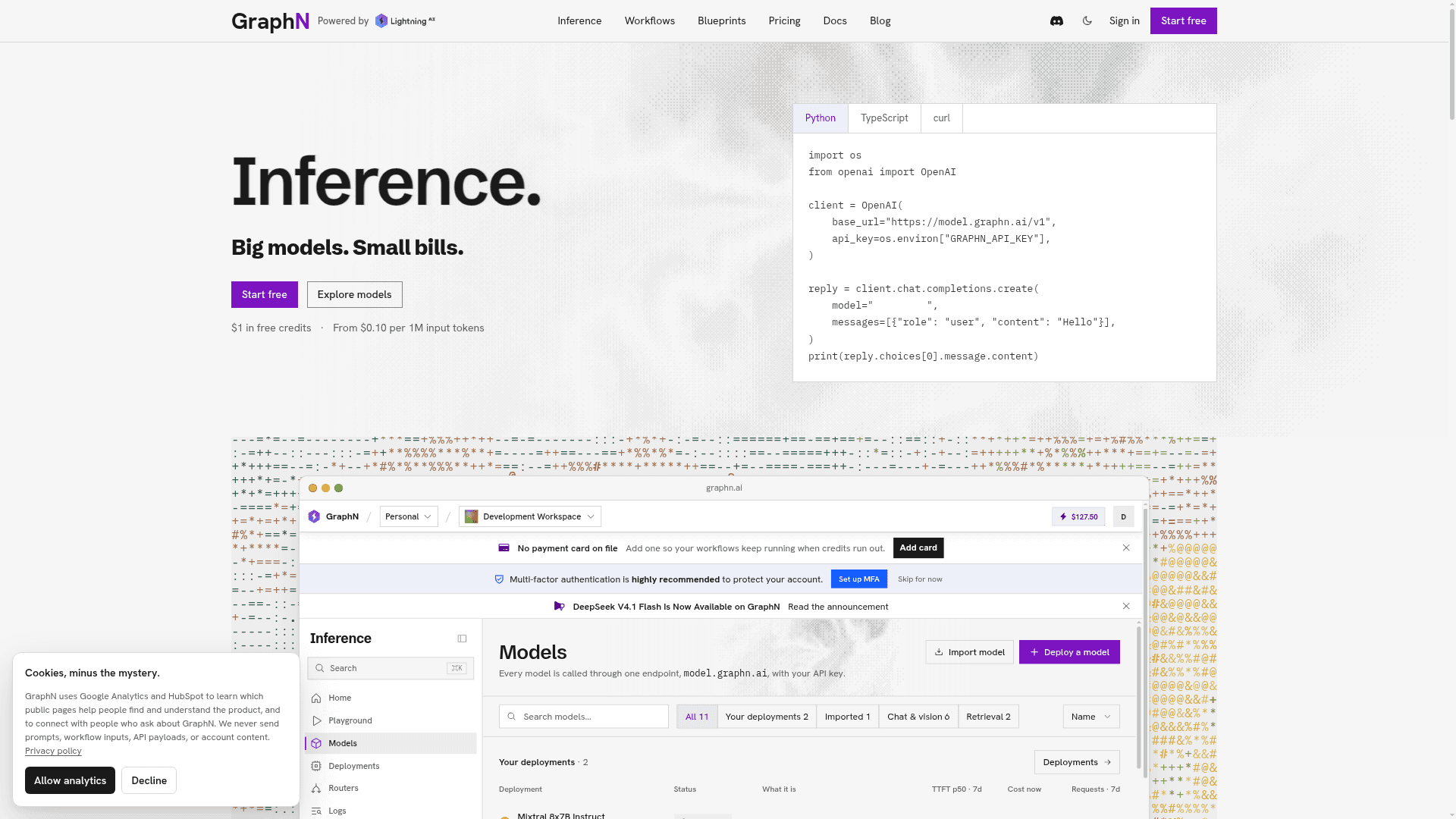
GraphN has two connected parts. The inference side serves built-in chat, vision, embedding, reranking and OCR models through a single endpoint (model.graphn.ai) using the OpenAI request shape, so existing OpenAI SDKs work by changing the base URL and API key. Models can also be imported from Hugging Face or S3 (including supported LoRA adapters), or registered as OpenAI-compatible endpoints such as vLLM or OpenRouter.
The workflow side lets teams define inputs, steps, data flow and outputs as an executable graph. Agents inside a workflow follow instructions on a selected model and can use Python functions, MCP tools, knowledge bases, storage and secrets.
How Workflows Are Built and Run
Workflows can be composed on a visual canvas or edited as YAML DSL, and the CLI validates and updates the same definition. Drafts can be dry-run before publishing; publishing creates a versioned snapshot that can be restored later. Published workflows are invoked through sync, async, batch or event gateways, and executions return status, output and a trace with per-node results and token usage. Blueprints provide ready-made starting points such as a support router, a pull request review bot and company knowledge search.
Model Routing and Observability
Sending the model name auto lets GraphN pick a model for each request, or teams can build their own router. A logs view records model, key, status, time to first token, tokens and cost for each call.
Working with Coding Agents and MCP
The graphn init command writes guidance files for Cursor, Claude Code, Codex and AGENTS.md so coding agents can build and edit workflows. Published workflows are also exposed as tools to MCP hosts such as Claude, ChatGPT and Cursor through a workspace MCP URL.
Community Discussions
Be the first to start a conversation about GraphN
Share your experience with GraphN, ask questions, or help others learn from your insights.
Pricing
LLM Inference (DeepSeek V4.1 Flash)
Built-in model billed per token
- Input $0.30 per 1M tokens
- Cached input $0.03 per 1M tokens
- Output $1.20 per 1M tokens
LLM Inference (Kimi K2.5)
Built-in model billed per token
- Input $0.60 per 1M tokens
- Output $3.00 per 1M tokens
- Cached input billed as input
LLM Inference (gpt-oss 120B)
Built-in model billed per token
- Input $0.15 per 1M tokens
- Output $0.60 per 1M tokens
- Cached input billed as input
Custom model GPU runtime
Custom model weights on GraphN-managed GPUs billed by runtime
- $6.50/GPU-hr
- $0.00180556/GPU-second
- LoRA adapters attached to a shared base are free
Platform meters
Metered platform usage
- KB embedding (BGE-M3) $0.02/1M input tokens
- Unstructured RAG ingestion $4.00/1,000 pages
- Markdown conversion $0.50/1,000 pages
- Object storage $0.069/GB-month
- Knowledge base vector storage $1.10/GB-month
- Function invocation $0.40/1M calls
- Function compute $0.06/GB-hour
- RAG job trigger Free
Capabilities
Key Features
- OpenAI-compatible managed inference endpoint
- Catalog of chat, vision, embedding, reranker and OCR models
- Import custom models from Hugging Face or S3 including LoRA
- Auto routing and custom routers
- Request logs with latency, token and cost data
- Visual workflow canvas and YAML DSL editor
- Dry-run testing and versioned publishing with restore
- Sync, async, batch and event workflow gateways
- Knowledge bases, storage, functions and secrets
- Publish workflows as MCP tools
- CLI with coding-agent skills for Cursor, Claude Code and Codex
- Prebuilt workflow blueprints