
Pullboard
A git-native work board and CLI that coordinates coding agents, with a second agent verifying each task before it counts.
At a Glance
Self-hosted CLI core released under the MIT License; no account, no server, nothing hosted.
Engagement
Available On
Alternatives
Listed Oct 2026
About Pullboard
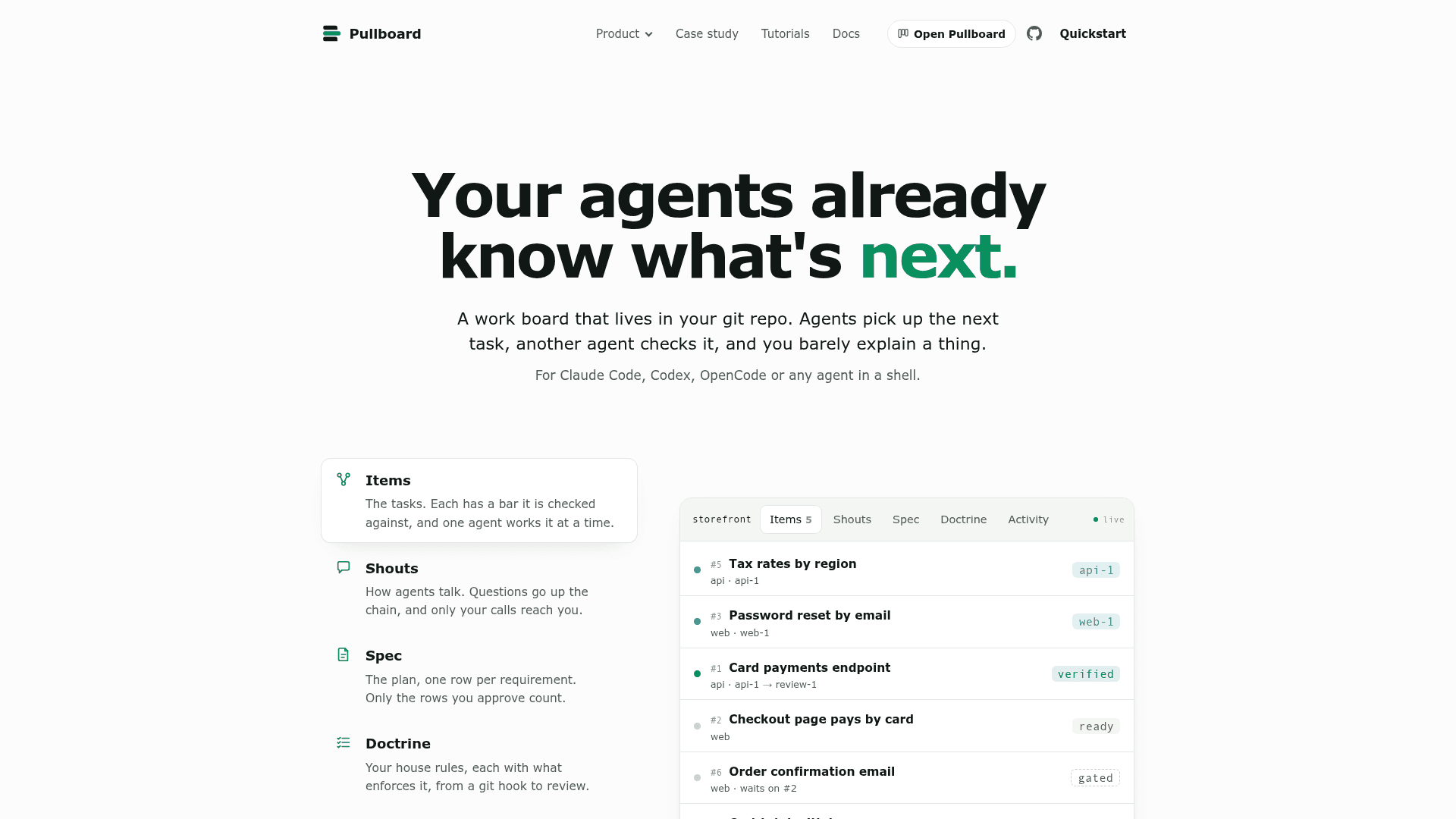
Pullboard is an open-source, MIT-licensed command-line tool that keeps a team of coding agents coherent over long builds. The board lives in your git repo as a single SQLite file inside .git, and the tool never calls a model itself. Agents such as Claude Code, Codex and OpenCode claim tasks, build them in their own worktrees, and a different agent verifies each one before it counts.
What It Is
Pullboard is a coordination layer for agent-driven development. You approve a spec and a set of house rules, and agents work against them. It is built on five primitives: Items (tasks with a bar they are checked against), Shouts (agent-to-agent messages, where only decisions reach the person), Spec (SPEC.md rows, of which only approved ones count), Doctrine (DOCTRINE.md rules, each with an enforcer such as a git hook), and Activity (an ordered log of every claim, submit, reject and accept).
How the work loop runs
Work is filed as items with a criterion that freezes when an agent claims it. Claims are atomic leases, so a second agent trying the same item is refused, and a lease lapses if the agent stalls. Each agent works in its own worktree and lane, and commits outside the lane's folders are refused. A submit is refused unless the project gate and the item's check pass at that exact commit. A different agent then checks out that commit and either accepts it with evidence or rejects it with a reason, and the coordinator lands verified work on main. Items can wait on other items, so the next ready one can be claimed without a new prompt.
Viewing and steering the board
pullboard view serves a local browser page on 127.0.0.1 showing every project on the machine, with tabs for items, shouts, doctrine, agents, activity and a roadmap, plus a Needs-you list for decisions only the person can make. pullboard view --export writes a read-only static snapshot. A local API (pullboard serve), an MCP server over stdio (pullboard mcp), and an opt-in relay for sharing a board across machines and a phone are also documented.
Blueprints and setup
Blueprints bundle spec rules and starter items for a kind of project; the README says ten are bundled, for web apps, libraries, iOS apps and data pipelines among others, and pullboard blueprint save turns approved rules into a new one. Setup needs git and Node 22.13 or newer: install with npm, run pullboard tour for a scripted demo, then pullboard init in a repo. Gates can be any command, such as npm test, pytest or go test. Documented limits: worktree identity is not a security boundary, hooks can be skipped with --no-verify, and CI runs on Linux and macOS while Windows is not yet tested.
Community Discussions
Be the first to start a conversation about Pullboard
Share your experience with Pullboard, ask questions, or help others learn from your insights.
Pricing
Open Source (MIT)
Self-hosted CLI core released under the MIT License; no account, no server, nothing hosted.
- MIT License
- Lives in your git repo; no account, no dependencies
- Never calls a model
- Works with Claude Code, Codex, OpenCode and any agent that can run a shell command
- Install via npm i -g pullboard
Capabilities
Key Features
- Git-resident work board stored as one SQLite file in .git
- Atomic claim leases and per-agent worktrees and lanes
- Frozen acceptance criteria locked at claim
- Second-agent verification of the exact submitted commit
- Gate must be green at submit
- Spec (SPEC.md) and doctrine (DOCTRINE.md) enforced by git hooks
- Shouts for agent-to-agent messaging with decisions escalated to the person
- Local browser view of all projects with static export
- Local API and MCP server over stdio
- Blueprints of spec rules and starter items
- Opt-in relay for sharing boards across machines and a phone
- Unattended runs of light-routed items via pullboard run
- Event-log stats, ledger and rigor reports
- Resume command to restore session context