Dev Highlights from Google I/O 2026

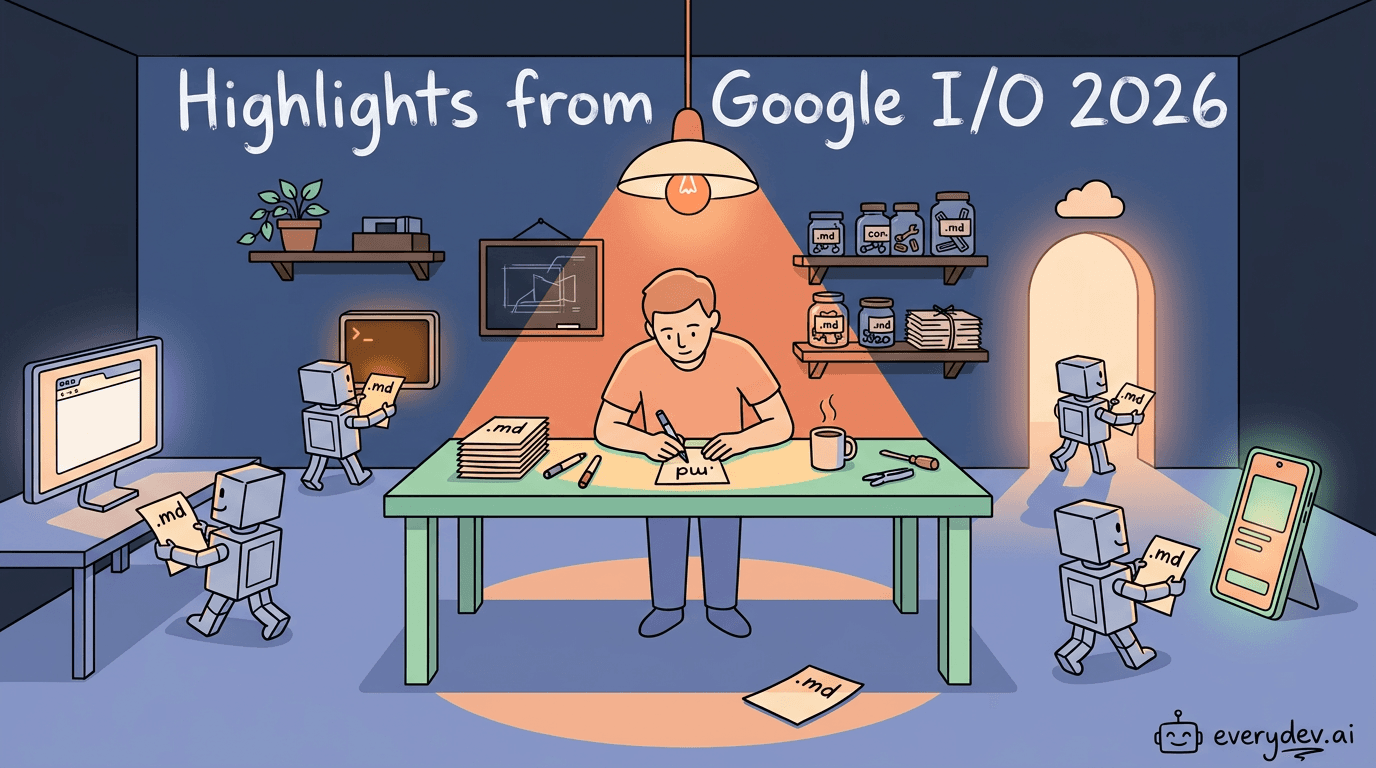
Logan Kilpatrick's line from Tuesday's developer keynote, framing the new managed-agents API: "Honestly, it feels like the hottest new programming language is markdown, and I'm here for it."
He got a chuckle. The rest of the morning made it look like a thesis.
Who this matters for: developer-tool makers, AI application builders, library and framework maintainers, and mobile or web developers whose stack just got cheaper to automate.
TL;DR
- Google unified its developer surface around agents: models, IDE, CLI, SDK, API, browser, and mobile.
- Markdown skill files became the standard configuration layer across Anthropic, Vercel, and Google.
- Managed Agents via a Gemini API call that provisions a persistent sandbox is the standout launch.
- WebMCP is a structural shift most outlets covered as a footnote; it could reorganize web dev by 2027.
- Chrome DevTools for Agents gives every coding agent a real Chrome plus Lighthouse audit loop.
- AI Studio shipped a prompt-to-Play-Store pipeline that compresses Android setup overhead.
- Gemini 3.5 Flash is the new default model: faster, half the price, replaces 3.1 Pro everywhere.
- Gemini Omni Flash, a "world model" that edits and generates video from any input, is live in the Gemini app and Flow; the developer API is still to come.
- Open risk: whether the skill-bundle format fragments by vendor over the next year.
Contents
- Gemini 3.5 Flash
- Gemini Omni
- Antigravity is now four products
- AI Studio: prompt to Play Store
- The agentic web
- Android: agents now do Android
- The markdown pattern
- What to do this week
- Where the bet could break
Gemini 3.5 Flash
Gemini 3.5 Flash replaces 3.1 Pro across the Gemini app, AI Mode in Search, and every Antigravity surface. Google says it beats 3.1 Pro on almost every benchmark, runs about 4x faster than other frontier models (Pichai said 12x in some configurations), and costs less than half of what comparable frontier models cost.
The cost line is what developers will feel. When orchestration is cheap enough to spin up five subagents per task without doing cost math, parallelism becomes the default planning approach for new work.
Gemini 3.5 Pro lands next month. Gemma 4 hit 100M downloads in its first month, pushing total Gemma downloads past 500M; still Apache 2, still offline-capable on phones.
Gemini Omni
Gemini Omni drew the loudest reaction of the keynote, and it has nothing to do with coding. Google calls it a "world model": feed it any mix of images, video, audio, and text, and it outputs video grounded in real-world physics, history, and culture. DeepMind CEO Demis Hassabis introduced it as "our new model that can create anything from any input" and called it "a step towards artificial general intelligence." The team that built it uses a blunter description: Nano Banana for video.
The headline capability is video editing through plain language, built on Google's media stack: Veo for generation, Nano Banana's editing approach brought to video, and Genie for real-world grounding. Veo could already generate video from an image or audio reference; Omni adds editing that holds character, voice, and motion consistent across changes. "Turn me into this animal" keeps the speech and body intact and changes only what you requested. Style transfer, scene continuation, and music-synced video all showed up as behaviors the team never trained for directly.
The practical edges matter. It is a small model, which is the "Flash" in the name. Clips run about 10 seconds, a single generation takes 60 to 90 seconds, and multi-turn editing holds for two to four turns before instruction-following degrades. Likeness runs through an avatar flow: a one-time capture of a few face angles and a voice sample that you reuse across products. Every output carries a SynthID watermark and C2PA metadata, and Google is gating personal-likeness generation behind that avatar flow while it watches how people use the model.
For developers, the line to note came near the end, when Logan Kilpatrick said "we will have APIs and other developer access." That access is not live yet. Today Omni Flash reaches consumers and creators through the Gemini app (Plus, Pro, and Ultra), through Flow for heavier creative workflows, and as a remix option in YouTube Shorts. Until the API lands, Omni sits to the side of the agents-and-markdown thread that ran through the rest of the keynote, pointing at where Google's models head next: any input, any output.
Antigravity is now four products
Google's Cursor competitor was split into four surfaces. Only the IDE is the one you already know.
Product | What it is | Why it matters Antigravity 2.0 (desktop) | Standalone multi-agent orchestration app | Direct Cursor competitor; adds subagent parallelism and cron Antigravity CLI | Terminal agent with the same harness and model | Replaces Gemini CLI; published migration guides Antigravity SDK | Programmatic access to the agent harness | Deploy on your own infrastructure Managed Agents (Gemini API) | Hosted agent + persistent Linux sandbox per request | Google's standout differentiator vs Anthropic and OpenAI
Two surfaces need more context: the Antigravity 2.0 additions, and Managed Agents.
Antigravity 2.0 additions
- Dynamic Subagents — the main agent spawns specialized helpers (QA, data science) that work in parallel.
- Scheduled Tasks — standard cron scheduling for autonomous runs: summarize PRs every morning, monitor cloud health every hour.
- One-click setup for Android, Firebase, and web stacks.
Project-level orchestration is now a first-class concept, which is the surface area Anthropic, Google, and Cursor are competing on.
Managed Agents on the Gemini API
A single Gemini API call provisions both an agent and an isolated Linux sandbox. Google manages the infrastructure. Three pieces:
- The Antigravity harness, exposed as an API. Co-optimized with Gemini 3.5 Flash. The agent loop is Google's; you don't build it.
- Persistent isolated environments. Each interaction creates a sandbox that resumes in follow-up calls with files and state intact. Multi-turn sessions without rebuilding context.
- Custom agent definitions via markdown. Instructions and skills written in plain
.mdfiles; templates live in the AI Studio Playground.
That third piece is where Kilpatrick's quote landed. Early-access partners include Stitch, Ramp, Resemble AI, and Klipy. Stitch used the sandbox to import design systems from GitHub into a design.md.
Compared against the other major vendors:
Capability | Anthropic Claude Agent SDK | OpenAI Agents API | Google Gemini Managed Agents Managed sandbox per request | No (BYO) | Limited | Yes, persistent Multi-turn state continuity | Manual | Conversation only | File + state Skill / instruction format | Markdown skills | Custom GPT format | Markdown skills Co-optimized harness + model | Yes (Claude) | Yes (GPT-5) | Yes (Gemini 3.5 Flash)
My take: the persistent file-backed sandbox provisioned by a single API call is the new primitive. Markdown skills show up in every column. Anthropic and OpenAI will likely add equivalents over the next two quarters.
Pricing: AI Ultra at $100/month
A new $100/month plan with 5x higher Antigravity usage than AI Pro. New and existing Ultra subscribers get $100 in bonus credits when they hit quota. Offer expires May 25, 2026.
AI Studio: prompt to Play Store
AI Studio's launches focused on collapsing setup time between prompt and deployed app.
- Cloud Run deploys in a few clicks. New users get a live URL with no credit card. Status, logs, and unpublish all run inside Studio.
- Native Android apps from a prompt, in Kotlin. Preview in the in-browser Android Emulator, plug in a phone for direct install, push to the Play Store from Studio if you have a connected Play Developer account. Trusted-tester sharing rolls out later this summer.
- Workspace integration with per-user OAuth. Connect Docs, Gmail, and Calendar via prompt; no SDK setup. The deployed app handles per-user OAuth at runtime, so end users sign in with their own Google account and the agent operates against their data with the scopes they granted. The developer never touches tokens or credential storage.
- Confirmation-before-action via prompt. From the livestream: "Look at my calendar, find any meeting and delete it, but definitely ask me before you do that." The agent surfaces the meetings and waits for approval.
- One-click export to Antigravity. Ports the full file system and context.
Mobile development has been slow to absorb the AI-coding wave because the device, the simulator, and the store pipeline each add their own setup overhead. Studio collapses the three into one product surface. For an indie mobile developer, or a web developer who's been put off by the Android toolchain, this is the first credible path to shipping a small native app inside a weekend.
The agentic web
Three Chrome team launches: Modern Web Guidance, WebMCP, and Chrome DevTools for Agents. The three together form Google's most coherent play of the day, because Google is the only vendor shipping the browser, the model, the coding agent, and the developer tools at the same time.
Modern Web Guidance
Expert-vetted markdown skills that teach AI coding agents how to use modern web platform features. Targets a Baseline version so the agent doesn't suggest APIs your users can't run, with fallbacks for newer features. 100+ use cases at launch. Google reports a 37-percentage-point pass-rate improvement over unguided coding on their internal benchmark.
Install:
npx modern-web-guidance@latest install
Compatible with Antigravity, Claude Code, Gemini CLI, Copilot CLI, and Vercel's npx skills. Google adopting the same skill-bundle format Anthropic and Vercel already use lowers the chance of platform-specific dialects forking the format, which has been the live question around skill standardization since late 2025.
For background on that fragmentation, see The fragmented state of AI agent rule files.
WebMCP
A proposed web standard letting sites expose JavaScript functions and HTML forms as structured tools that browser-based agents can call directly. Experimental origin trial in Chrome 149. Gemini in Chrome will support published WebMCP tools soon. Vendor-agnostic: any compliant browser agent can call the same tools.
The on-stage demo took a car configurator and made it fully agent-controllable after a single Antigravity prompt, with Gemini in Chrome driving the interactions. The site declared what its agent-callable tools were, and the browser agent invoked them directly rather than simulating clicks and parsing the DOM.
For the past two years, agents have driven the web by impersonating users. WebMCP replaces impersonation with declaration. Sites publish tools, agents call those tools through the browser, and the brittle scrape-and-pray layer goes away.
My take: WebMCP is the under-covered announcement of the keynote. If Safari and Firefox follow within a year, the agent-controllable web is one of the few platform shifts that could reorganize web development by 2027.
Chrome DevTools for Agents
A closed feedback loop for coding agents: real Chrome to drive, with Lighthouse and the DevTools toolset exposed over MCP or CLI. A new Lighthouse "agentic browsing" category validates WebMCP tool registrations, declarative form metadata, and llms.txt. The agent reads the report, attempts a fix, and re-runs the audit without copy-pasting errors into a chat window.
Available today for Antigravity and 20+ other coding agents:
# Claude Code
/plugin marketplace add ChromeDevTools/chrome-devtools-mcp
/plugin install chrome-devtools-mcp

# Codex
codex mcp add chrome-devtools -- npx chrome-devtools-mcp@latest

# Gemini CLI
gemini extensions install --auto-update https://github.com/ChromeDevTools/chrome-devtools-mcp
If your current agent verification step is type-checking or test pass-rate, adding real Chrome plus Lighthouse to the loop is the largest cheap quality upgrade available this week.
HTML-in-Canvas
Real DOM elements rendered inside a Canvas: searchable, accessible, translatable, autofill-compatible. WebGL and WebGPU textures can interact with live DOM. Origin trial open now. The on-stage demo rendered a car interior screen in 3D with clickable HTML controls baked into the model.
If the API ships and other browsers implement it, the standing objection that 3D and AR interfaces can't use real form controls goes away.
Android: agents now do Android
Two pieces matter.
The Android CLI is now stable inside Antigravity. It handles SDK downloads, project creation, and running apps on devices, which lets any LLM-powered agent operate on Android projects without Android Studio installed. It ships with an Android Knowledge Base and a set of open-sourced Android Skills (markdown, again) for edge-to-edge migration, XML-to-Compose conversion, and Jetpack Navigation 3. Google's internal numbers: 70% fewer tokens used, tasks completed up to 3x faster than unguided agents.
The Migration Assistant in Android Studio ships in preview later this year. File > New Project > Migrate to New Project. Point it at a React Native, web, or iOS source, and the agent maps features, plans the project, migrates code, handles Xcode storyboards to Android screens, string migration, and SVG/PDF-to-vector-drawable conversion. It implements with Jetpack Compose, Room, ViewModels, and predictive back nav. It uses Journeys (natural-language test instructions) to validate its own work. Kotlin Multiplatform support is in progress so shared business logic can stay shared.
iOS-to-Android migration is the headline use case Google is selling here. The framing is the most aggressive market move in the keynote: Google using agents to lower the cost of switching mobile platforms toward Android.
The markdown pattern
The skill-bundle pattern now sits underneath:
- Antigravity (agent definitions)
- Gemini API Managed Agents (custom agents)
- Modern Web Guidance (web platform usage)
- Android Skills (Android development)
- Chrome DevTools for Agents (via
llms.txt)
Every major agent platform is converging on this format. Anthropic shipped skills late last year. Vercel shipped npx skills. The community-favorite Karpathy-style judgment files (CLAUDE.md, AGENT.md) have crossed 100K stars on GitHub. Google is now backing the same primitive across every developer surface they own.
If you maintain a library, a framework, or a platform, a markdown skill bundle belongs on your near-term roadmap. Documentation sites and SDK guides describe what your product does. A skill bundle drops into an agent's context window and teaches the agent how to use your product correctly without being asked.
My take: vendors that ship a skill bundle before Q3 will compound the advantage through the rest of the year as more developers default to running agents on their work.
What to do this week
If you're building developer tools or shipping AI features:
- Install Chrome DevTools for Agents. Setup is five minutes and works with any agent.
- Run
npx modern-web-guidance@latest install. Pairs with any markdown-skill-aware agent. - If you're on AI Ultra, claim the $100 in Antigravity credits before May 25.
- If you use Gemini CLI in production, read the Antigravity CLI migration guide now rather than waiting for the deprecation date.
- If you ship a library or developer tool, start a
skills/directory in your repo. Three markdown files is enough to begin.
Where the bet could break
Google put models, IDE, CLI, SDK, API, browser, and mobile all behind the same agent thesis on the same morning. The strategy is coherent. Where it breaks will most likely be in one of three places.
Managed sandboxes need to be reliable enough that developers trust them with persistent state. Google's track record on long-running developer infrastructure is mixed (App Maker, Stadia, and several products you've already forgotten). State-resuming sandboxes are also operationally harder than stateless functions, and any outage will affect every customer at once.
WebMCP needs adoption from other browser vendors. If Safari and Firefox don't follow within a year, it stays a Chrome-only feature that developers can't rely on for general distribution, and the agentic-web argument shrinks back to "Gemini in Chrome can drive these sites."
The skill format could fragment. Anthropic's skills, Vercel's npx skills, Google's Modern Web Guidance, and Android Skills are all currently compatible, but each vendor has incentives to add proprietary extensions. The next twelve months will tell whether convergence holds or whether the rule-file fragmentation from 2025 repeats one layer up.
The question for builders to focus on is what your product does when an agent shows up and asks what it can do here. If the answer involves no skill bundle, no published tool surface, and no agent-friendly docs, that gap will widen month by month from now.
— Joe
Further Reading
- Antigravity 2.0 announcement: https://antigravity.google/blog/introducing-google-antigravity-2-0
- Antigravity I/O 2026 post: https://antigravity.google/blog/google-io-2026
- Antigravity Python SDK: https://github.com/google-antigravity/antigravity-sdk-python
- Antigravity CLI on EveryDev: https://www.everydev.ai/tools/antigravity-cli
- AI Studio Mobile / Android: https://aistudio.google.com/mobile
- Modern Web Guidance: https://developer.chrome.com/docs/modern-web-guidance
- Chrome DevTools for Agents: https://developer.chrome.com/docs/devtools/agents
- Chrome DevTools MCP repo: https://github.com/ChromeDevTools/chrome-devtools-mcp
- Google developer keynote roundup: https://developers.googleblog.com/all-the-news-from-the-google-io-2026-developer-keynote/
- Full I/O hub: https://io.google
- Developer keynote video: https://www.youtube.com/watch?v=aqmpZocmR8o
Comments
No comments yet
Be the first to share your thoughts