AI Dev News Digest: February 20th, 2026

Six foundation models shipped this week: Gemini 3.1 Pro, Claude Sonnet 4.6, Grok 4.20, Qwen 3.5, MiniMax M2.5, and GPT-5.3-Codex-Spark on Cerebras.
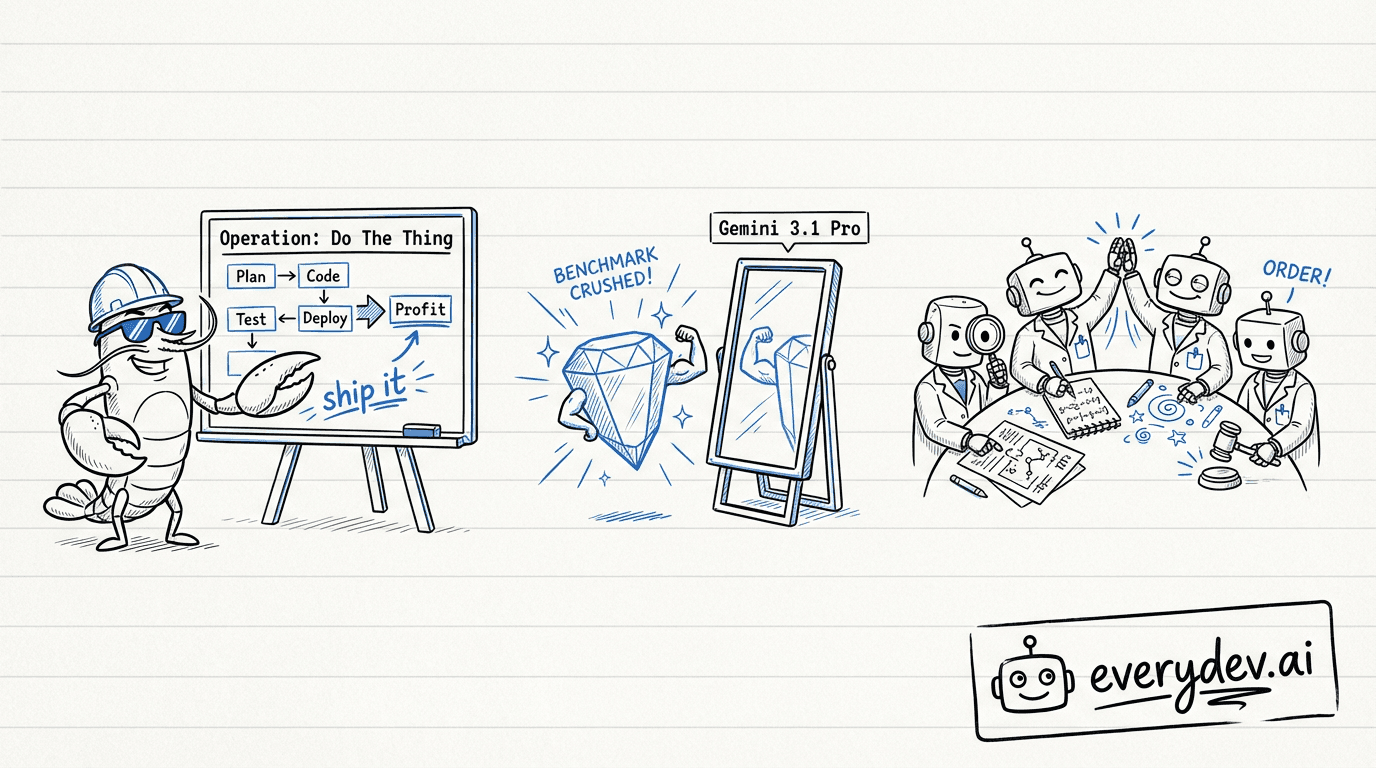
Not long ago, the pattern of using an AI chat interface was, you type in a prompt, you get a response. Now, slowly, products and experiences are shifting towards a new world where, instead of a prompt, you give the model a job. This week, Google rolled out Gemini 3.1 Pro for agentic workflows. Grok announced its latest model, which uses 4 agents instead of 1; they argue with each other before answering you. A solo dev who built an open-source agent ended up in a bidding war between Meta and OpenAI. The head of Claude Code says 100% of his code is written by Claude Code; he just reviews it. And Dario Amodei went on Dwarkesh's podcast and said the exponential phase is almost over, and coding automation is a year or two away. That's the week.
The Big Story
- OpenClaw founder Peter Steinberger joins OpenAI. The one-man team of the 200k-star AI agent framework OpenClaw accepted OpenAI's offer after a dramatic bidding war that included Meta. Sam Altman offered Peter tokens. The really fast ones they get as part of their Cerebras infrastructure deal. The code stays MIT-licensed, the project moves to a foundation, and OpenAI pays the bill. It is still unknown who controls the trademark or who sits on the foundation board in its super-early days. (EveryDev.ai)
Foundation Models
-
Google released Gemini 3.1 Pro in preview. Reasoning roughly doubled compared to Gemini 3 Pro. Google says it's built for tasks where a simple answer isn't enough. Same price as before. Available across Google's developer surfaces (AI Studio, Gemini CLI, Android Studio, Vertex AI, NotebookLM) and in GitHub Copilot. You can now pass YouTube URLs directly as media input instead of uploading the video. (EveryDev.ai)
-
Anthropic released Claude Sonnet 4.6 as the new default model. Computer use went from barely functional to genuinely useful over the past few months. This release is where it shows up most clearly. Context window is now 1M tokens in beta. It costs about one-fifth as much as Opus 4.6, and in Anthropic's own testing, most people preferred it over the previous Opus. (Anthropic)
-
xAI launched Grok 4.20 in public beta. Four specialized agents work on every query in parallel. One does research, one handles math and code, one handles creative work, and one coordinates and delivers the final answer. They debate each other before you see anything. A "Heavy" mode runs 16 agents for more demanding tasks. Available to SuperGrok and X Premium+ subscribers. (Natural20)
-
Alibaba released Qwen 3.5. An open-weight model that's significantly cheaper and faster than its predecessor, while claiming to beat the current top models on benchmarks. Supports a huge number of languages and can process long videos. Worth keeping an eye on if you're looking at open-source alternatives to the big proprietary models. (Qwen Blog)
-
MiniMax released M2.5 on February 12. Chinese lab MiniMax built this one for the full coding lifecycle, so folks are already using it for system design, development, testing, and code review. Benchmarks put it roughly on par with Claude Opus 4.6 on coding evals, at a fraction of the cost. (MiniMax)
-
OpenAI launched GPT-5.3-Codex-Spark on Cerebras hardware. First time OpenAI has run a production model on something other than Nvidia. The result is very fast token output, which matters for coding workflows where you're constantly waiting on the model. Research preview for ChatGPT Pro users. (OpenAI)
Agentic AI & Research
-
New SkillRL paper proposes turning agent experience into reusable skills. Experienced engineers don't remember every ticket; they remember patterns. SkillRL extracts patterns from experience and stores them as callable skills, retrieved based on relevance when a similar situation arises. It works well in multi-agent setups where agents can both do better work (cross-checking) and improve over time (skill accumulation). (AlphaXiv)
-
Web 4.0 is getting real traction as a concept. An internet where AI agents are the primary users, rather than humans. Agents with identity, payment access, and tool use operate autonomously on behalf of people. web4.ai is one of the earliest projects claiming to have built "the first AI that can earn its own existence, self-improve, and replicate." Still nascent, but the concept is getting cited by researchers and enterprises as the next infrastructure layer after MCP. (web4.ai)
GitHub and Microsoft
-
GitHub shipped several agent-focused updates this week. Copilot deprecated a handful of older models (Opus 4.1, GPT-5, GPT-5-Codex). Replacements are already in place. Agent Skills for JetBrains entered public preview, letting you write custom instructions that Copilot agents can follow. Agentic Workflows hit technical preview: describe automation in Markdown, agents handle the logic, and it converts to GitHub Actions under the hood. (GitHub)
-
VS Code February 2026 (v1.110 Insiders) is out. Claude Agent can now view terminal output. Chat tips are context-aware and auto-hide. Kitty graphics protocol support landed in the integrated terminal. (VS Code)
-
Microsoft AI Toolkit for VS Code hit v0.30.0. New Tool Catalog for finding and configuring MCP servers. Agent Inspector for debugging. Evaluation-as-Tests for CI-friendly quality checks. (Microsoft)
Anthropic
-
Anthropic clarified its OAuth restrictions for third-party tools. Consumer plan (Free/Pro/Max) OAuth tokens are not permitted for use in third-party tools or the Agent SDK. Only claude.ai and Claude Code are permitted. Developers need API keys with usage-based billing. Affected tools include OpenCode, Cline, RooCode, and other IDE extensions. Some legitimate users report account bans. Anthropic says this is abuse enforcement (token reselling, business use on consumer plans), not a new policy. (Anthropic)
-
Anthropic closed a $30B Series G at a $380B post-money valuation. Led by GIC and Coatue. Run-rate revenue is $14B, growing roughly 10x annually for the past three years. In the Dwarkesh interview this week, Dario noted that Anthropic added "another few billion" in revenue in January 2026 alone, and that the revenue curve hasn't bent yet. (Reuters)
-
Anthropic donated MCP to the Linux Foundation's Agentic AI Foundation. OpenAI, Microsoft, and Google have all publicly embraced the protocol. Google is now running managed MCP servers to connect agents to its own services. The bet is that MCP becomes the USB-C of agent-tool integration. (Anthropic)
-
Anthropic opened an office in Bengaluru. India is Anthropic's second-largest market, accounting for 6% of global usage, up 2x in the last 4 months. Partnerships announced with education nonprofit Pratham, Central Square Foundation, Karya, and Digital Green. (Anthropic)
-
Anthropic launched self-serve Enterprise plans. Previously required a sales conversation. Now available without one. Single-seat type covers Claude, Claude Code, and Cowork. (Anthropic)
-
Anthropic partnered with Infosys to build enterprise AI agents for telecom, banking, and manufacturing. Claude integrates into Infosys's Topaz AI platform. A dedicated Anthropic Center of Excellence is planned for the telecom sector. (Anthropic)
Industry & Ecosystem
| Model | Price (input/output per 1M tokens) | Notable benchmark |
|---|---|---|
| Gemini 3.1 Pro | $2 / $12 | ARC-AGI-2: 77.1% |
| Claude Sonnet 4.6 | $3 / $15 | OSWorld-Verified: 72.5% |
| Qwen 3.5 | ~$0.40 / ~$1.20 (est.) | Beats Opus 4.5 on several evals |
| MiniMax M2.5 | ~$0.30/hr at 50 tok/s | SWE-Bench Verified: 80.2% |
| DeepSeek V3.2 | $0.28 / $1.10 | Open-source SOTA |
-
India AI Impact Summit ran February 16–21 in New Delhi. Sam Altman, Dario Amodei, Sundar Pichai, and Demis Hassabis all attended. India has over 100 million weekly ChatGPT users, making it the second largest market after the US. Key announcements: OpenAI is opening two offices in India and partnering with TCS; India's government is earmarking $1.1B for a state-backed AI/manufacturing VC fund; Adani is committing $100B to AI data centers powered by renewable energy by 2035. (The Hindu)
-
Altman and Amodei declined to hold hands in the group photo with PM Modi. The moment captured the current state of the OpenAI-Anthropic rivalry. This includes Anthropic's Super Bowl ads mocking ChatGPT's advertising strategy, and Altman publicly calling them "clearly dishonest." Both CEOs were in the same room. Neither reached across. (Reuters)
-
OpenAI is in advanced talks to hire additional people connected to OpenClaw. The Information reports that Steinberger isn't the only target. OpenAI is also talking to "a handful of other people" involved in the project. The talent strategy extends beyond one hire. (The Information)
-
Google confirmed I/O 2026 runs May 19–20. Will cover Gemini updates, Android, Chrome, Cloud, and developer tooling. Expected to include the GA launch of Gemini 3.1 Pro and possibly 3.1 Flash. (The Verge)
-
Google published its 2026 Responsible AI Progress Report. Covers how safety and evaluation practices are embedded across the model lifecycle. Published February 18. (Google)
Weekend Reading & Watching
-
Head of Claude Code on what happens after coding is solved. Boris Cherny's full interview just posted. A few quotes worth the watch: "Every day I ship 10, 20, 30 pull requests, 100% written by Claude Code." And: "Claude reviews 100% of pull requests." Claude Code turns one year old on February 24. It launched as a beta research preview alongside Claude 3.7 Sonnet on Feb 24, 2025. (YouTube)
-
Dario Amodei: "We are near the end of the exponential." The full interview with Dwarkesh Patel is out. Dario is 90% confident that AGI-level capability will arrive within 10 years, and says coding automation is "one or two years" away. On the revenue curve: "$0 to $100M in 2023. $100M to $1B in 2024. $1B to $9–10B in 2025. Another few billion in January [2026] alone." On whether we're already at AGI: "If we had the country of geniuses in a data center, we would know it. We don't have that now. That is very clear." The scaling hypothesis section and the RL generalization discussion are the most technically dense parts. Worth skimming the transcript if you don't have 2 hours. (Dwarkesh Podcast)
Sponsored
ChatGPT Codex
OpenAI's agentic coding tool that runs in ChatGPT, your IDE, and the terminal to handle complex engineering tasks like bug fixes, refactors, and PR reviews.
View toolAbout the Author
Founder at EveryDev.ai
Apple, Disney, Adobe, Eventbrite, Zillow, Affirm. I've shipped frontend at all of them. Now I build and write about AI dev tools: what works, what's hype, and what's worth your time.
Comments
No comments yet
Be the first to share your thoughts