AI Dev News Digest: March 6th, 2026

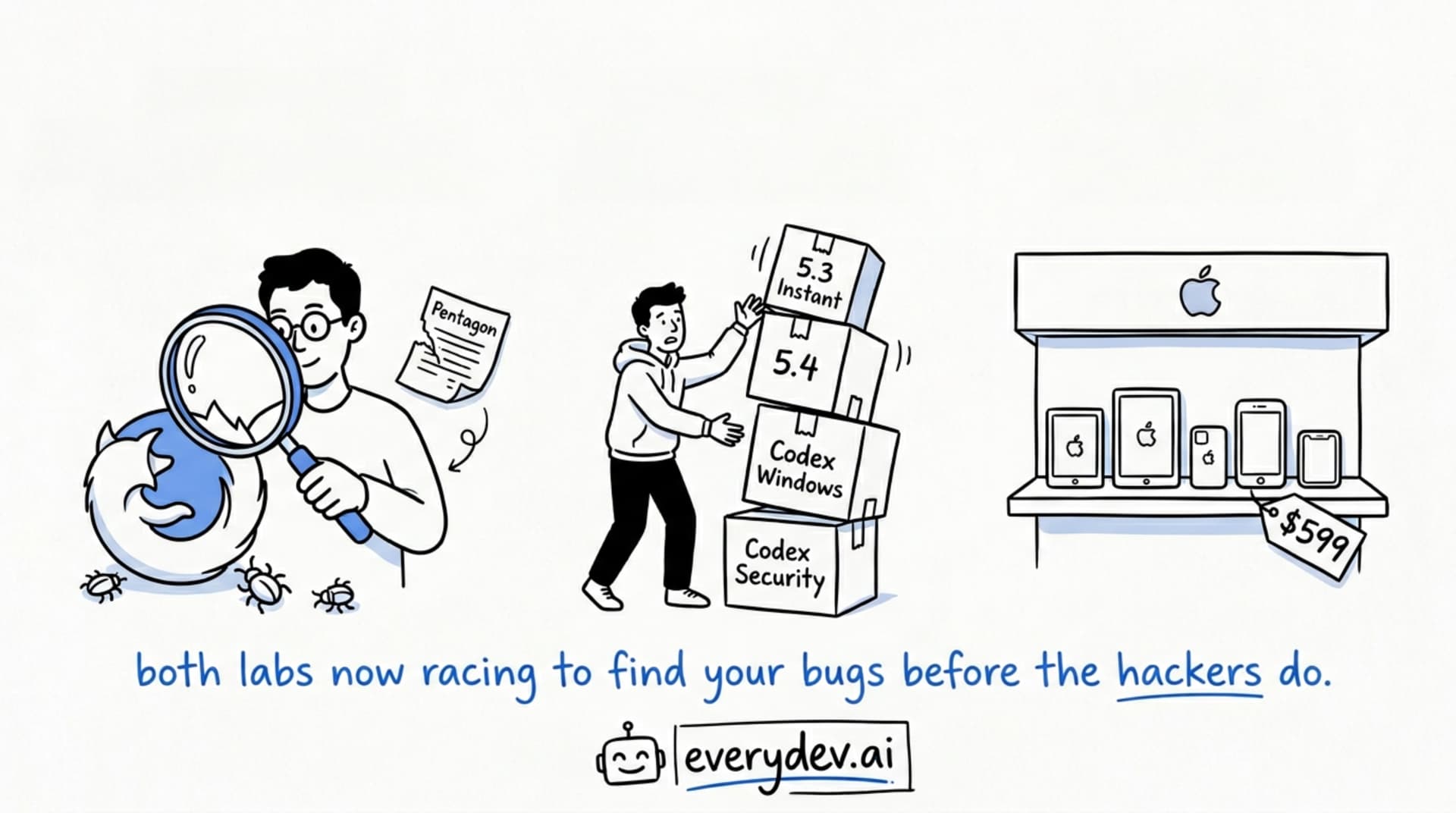
Anthropic turned down the Pentagon, was blacklisted, and then saw Claude signups reach a million per day. They launched Import Memory, which lets you copy your ChatGPT memories into Claude. At the same time, Dario Amodei's leaked memo called OpenAI's military contract "safety theater." These events were closely connected.
OpenAI responded with GPT-5.3 Instant, GPT-5.4, the Codex Windows app, and Codex Security, all in one week. Both labs are now racing to find more bugs: Anthropic found 22 Firefox zero-days, and OpenAI scanned 1.2 million commits for bugs. Apple announced seven products in three days. Cursor reached $2B in revenue. Google released an Android developer benchmark. Vercel's Dubai region went offline after Iranian missile strikes, which disrupted builds worldwide. Another busy week.
The Pentagon, the Memo, and the Fallout
-
Dario Amodei's leaked memo calls OpenAI's Pentagon deal "safety theater." A 1,600-word internal memo obtained by The Information accuses OpenAI of "straight up lies" about its military contract. Amodei wrote that OpenAI cared about "placating employees," while Anthropic "actually cared about preventing abuses," and that the Trump admin targeted Anthropic because it hadn't donated to Trump, unlike Brockman ($25M to MAGA Inc) and Altman ($1M to the inauguration). The quote that won't stay internal: OpenAI's spin is "working on some Twitter morons." (TechCrunch)
-
Anthropic challenges its "supply chain risk" label in court. In an official statement, Amodei confirmed the formal designation and said Anthropic will fight it, calling the action "legally unsound." He apologized for the leaked memo's tone, calling it "out-of-date" and written hours after Trump's Truth Social post, the designation, and the OpenAI deal all landed on the same day. Anthropic is offering to continue providing Claude to the military at nominal cost during the transition. (Anthropic)
-
QuitGPT hits 2.5 million participants. Claude surpasses ChatGPT in US daily downloads. The boycott movement exploded after Anthropic refused the Pentagon's terms and OpenAI signed hours later. Anthropic says over a million people are now signing up for Claude per day. To make switching easier, Anthropic launched Import Memory, a two-step copy-paste flow that transfers your stored memories from ChatGPT, Gemini, or any other provider into Claude's memory settings. Available on all paid plans. (Euronews, Anthropic)
AI Security Arms Race
-
Claude Opus 4.6 found 22 Firefox vulnerabilities in two weeks, 14 high-severity. Anthropic partnered with Mozilla and scanned nearly 6,000 C++ files. Claude found its first Use After Free vulnerability within twenty minutes and submitted 112 unique reports total. Mozilla patched the issues in Firefox 148. The more concerning finding: Claude also developed crude browser exploits in two cases, though only after removing some security features. The gap between finding bugs and exploiting them may not last. (Anthropic)
-
OpenAI launches Codex Security and Codex for OSS. Codex Security builds a project-specific threat model, validates findings in sandboxed environments, and proposes patches. Beta results: noise down 84%, false positives down 50%+, severity over-reporting down 90%. Over the last 30 days, it scanned 1.2 million commits, flagging 792 critical and 10,561 high-severity issues across projects like OpenSSH, GnuTLS, and Chromium (14 CVEs assigned). Free for the first month to Enterprise, Business, and Edu customers. Codex for OSS gives eligible open-source maintainers 6 months of ChatGPT Pro with Codex, access to Codex Security, and API credits. (OpenAI, OpenAI)
OpenAI's Busiest Week
-
GPT-5.4 launches with 1M token context, native computer use, and three variants. Standard, Thinking (reasoning), and Pro (max capability). Scored 75% on OSWorld-Verified for desktop navigation, beating reported human performance of 72.4%. Factual errors down 33% vs GPT-5.2, token usage down 47% on some tasks via a new Tool Search system. Also shipping: Excel and Google Sheets integrations under "OpenAI for Financial Services." (OpenAI, TechCrunch)
-
GPT-5.3 Instant ships for faster everyday conversations. Speed-optimized variant targeting ChatGPT's consumer experience: 26.8% fewer hallucinations on web-sourced answers, reduced overrefusal. One hour after announcing it, OpenAI tweeted "5.4 sooner than you think." They weren't kidding. (OpenAI)
-
Codex app lands on Windows with an open-source native sandbox. 500k developers were on the waitlist. OpenAI built a Windows-native agent sandbox with Microsoft using OS-level isolation so devs can stay in PowerShell without WSL. The sandbox is open-source. Codex is now available to ChatGPT Free and Go users, with double rate limits for paid plans through April 2. (OpenAI)
Apple's Seven-Product Week
Apple ran a week of press releases from March 2-4, announcing seven products at simultaneous events in New York, London, and Shanghai. Everything ships March 11.
-
MacBook Pro with M5 Pro and M5 Max. The dev headline: 4x faster LLM prompt processing vs M4, Neural Accelerators in every GPU core, M5 Max supports 128GB unified memory at 614GB/s. Apple is explicitly marketing these as local LLMs (LM Studio appears in the press images). SSDs hit 14.5GB/s. Starts at $2,199. (Apple)
-
MacBook Neo at $599. Apple's first Mac powered by an iPhone chip (A18 Pro). Single-core actually beats the M1 Air by 47% (3461 vs 2346) and outscores Intel's latest Panther Lake 388H. Multi-core is roughly on par with M1. The real concern from forum discussions: half the memory bandwidth of M1, and 8GB with no upgrade path. Education pricing at $499 targets Chromebooks. The $699 model adds Touch ID and 512 GB of storage. (Apple, MacRumors)
-
MacBook Air M5, Studio Display, and Studio Display XDR. The Air now starts at 512GB of storage for $1,099. The regular Studio Display adds Thunderbolt 5 but keeps the 60Hz refresh rate at $1,599. The new Studio Display XDR is the real upgrade: 27-inch 5K, mini-LED, 120Hz ProMotion, 2,000 nits peak HDR. Starts at $3,299. (Apple, Apple)
-
iPhone 17e and iPad Air M4. The iPhone 17e ($599) finally gets MagSafe and an A19 chip. The iPad Air gets the M4 chip and Wi-Fi 7 at the same $599 starting price. (Apple)
Coding Tools
-
Cursor launches Automations for always-on coding agents. Agents trigger automatically from commits, Slack messages, PagerDuty incidents, or timers. It extends Bugbot (which already reviews every commit) to security audits, incident response, and weekly codebase digests. Internally, Cursor runs hundreds of automations per hour. Bloomberg reported Cursor's annualized revenue hit $2 billion, doubling in three months. (TechCrunch)
-
Google launches Android Bench, the first official LLM leaderboard for Android development. Tasks sourced from real GitHub Android repos covering Compose migrations, SDK breaking changes, wearable networking, and more. Results: Gemini 3.1 Pro Preview leads at 72.4%, Claude Opus 4.6 at 66.6%, GPT 5.2 Codex at 62.5%, down to Gemini 2.5 Flash at 16.1%. Methodology and test harness are open-source. (Google)
-
Google Workspace CLI ships with the MCP server and 100+ agent skills.
gwsis a Rust-based CLI that dynamically builds its command surface from Google's Discovery Service at runtime, covering Drive, Gmail, Calendar, Sheets, Docs, Chat, and Admin. Any MCP-compatible client can call Workspace APIs as tools. 5.1k GitHub stars. Not officially supported by Google despite living under thegoogleworkspaceorg. (GitHub) -
OpenCode Desktop shows off a polished UI/UX. The open-source coding agent (114k GitHub stars) now has a Tauri-based desktop app with LSP integration, multi-provider support, and session management. Still beta, but the design direction is turning heads. (X)
Infrastructure
-
Vercel's Dubai region goes offline after Iranian strikes hit UAE infrastructure. Starting March 2, the dxb1 region failed, and because Middleware Functions are deployed globally, a single region failure disrupted builds worldwide. Traffic rerouted to Mumbai. Intermittent issues continued through the week. Your deployment is only as reliable as the least reliable region in the set. (Vercel Status, AutoSmoke)
-
Wikipedia was locked down after a self-propagating JavaScript worm. A dormant malicious script uploaded to Russian Wikipedia in March 2024 was accidentally triggered by a Wikimedia employee during a security review. The worm modified the global Common.js, self-propagated through editors who loaded it, and hit ~4,000 pages and 85 user scripts in 23 minutes before Wikimedia set everything to read-only. No data breached. (BleepingComputer)
-
"Clinejection" postmortem: a GitHub issue title compromised 4,000 developer machines. Detailed write-ups landed this week on a February supply chain attack against Cline, the AI coding tool. The attack chain: someone injected a prompt into a GitHub issue title, which Cline's AI triage bot (Claude via
claude-code-action) interpreted as an instruction and executed. That led to cache poisoning, credential theft, and a compromised npm package (cline@2.3.0) that silently installed OpenClaw on every machine that updated during an 8-hour window. The entry point was natural language. The security researcher who discovered it in December waited five weeks for a response before disclosing publicly. A separate attacker weaponized the PoC eight days later. Cline has since moved to OIDC provenance for npm publishing. (Snyk, grith.ai)
Open Source
- Qwen's lead researcher and core contributors resign from Alibaba. Junyang Lin posted "me stepping down. bye my beloved qwen." on X. Several other leads for Qwen-Coder, post-training, and VL models followed. The timing is painful: Qwen 3.5 is arguably the best open-weight model family available, with a 2B reasoning+vision model at 1.27GB quantized. A re-org placing a Google Gemini hire above Lin reportedly triggered the departures. Alibaba's CEO held an emergency all-hands. (Simon Willison)
Weekend Reading
-
Anthropic's labor-market paper finds no unemployment spike, but young-worker hiring is slowing. Their new "observed exposure" measure puts computer programmers at 75% task coverage. No systematic unemployment increase for exposed workers since late 2022, but a 14% drop in hiring rates for 22-25 year olds in exposed occupations. (Anthropic)
-
"Ape coding." A satirical future encyclopedia entry about humans deliberately writing code by hand. It starts as derogatory slang for developers who can't use AI agents, gets reappropriated by skeptics, fades into obscurity, then revives as a recreational hobby. The kicker: human hobbyists attempting to build a compiler for an AI-designed programming language have already had a schism over rewriting it in Rust. (Rômulo Saksida)
Sponsored
ChatGPT Codex
OpenAI's agentic coding tool that runs in ChatGPT, your IDE, and the terminal to handle complex engineering tasks like bug fixes, refactors, and PR reviews.
View tool
Comments
Checking profile…