
Issue #21 · Weekly Digest
Weekly AI Dev News Digest: May 16 - May 22, 2026
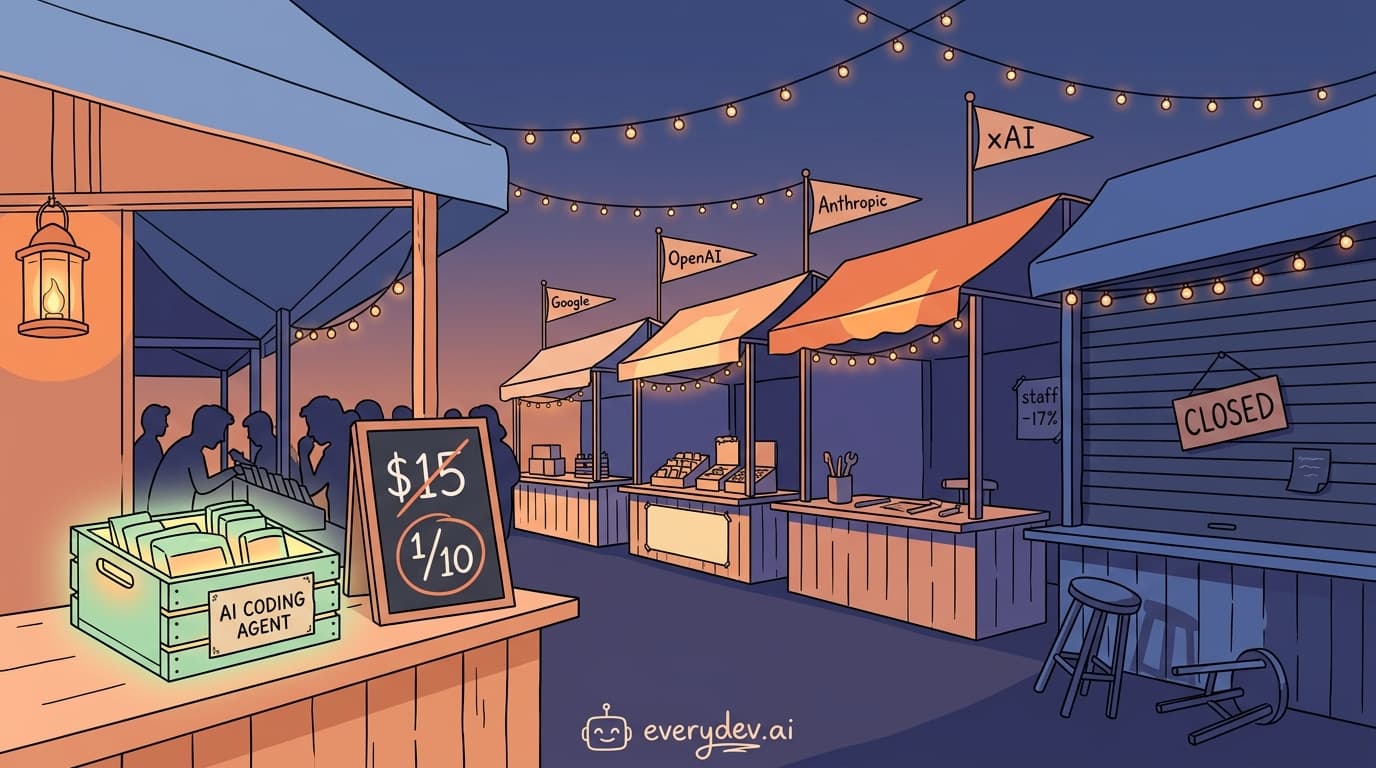
Frontier-grade coding fell to a tenth of its price the same week three companies named AI, in writing, as the reason they were cutting staff. The cheaper the tools get, the smaller the payroll behind them, and the same few vendors are working both sides of that trade.
Google's I/O keynote was the loudest event of the week: a new Gemini family, a from-scratch rewrite of Antigravity into an agent platform, a browser standard for letting agents click through websites, and OpenAI agreeing to watermark its images with Google's SynthID, a deal almost nobody predicted. Two smaller facts mattered more to your job. Cursor released a model that matches Claude Opus 4.7 at a tenth the price, and three companies announced layoffs that doubled as AI strategy memos.
That gap is the story. Tools keep getting cheaper, faster, and easier to wire together: MCP turned up as a real feature in four unrelated products, and an OpenAI model cracked a geometry problem open since 1946. The cuts came from ClickUp, Intuit, and Meta, even as Andrej Karpathy left his own startup for Anthropic and the labs kept hiring. GitHub got robbed through one of its own VS Code extensions. Plenty to get through.
1/10
Opus 4.7's price, matched
22%
of ClickUp gone
8,000
Meta roles cut, 7,000 moved to AI
3,800
GitHub repos stolen
$852B
OpenAI's last valuation
1946
conjecture broken
In Focus
Cheap Coding Agents
Cursor's Composer 2.5, out Monday, is the most aggressive pricing move yet in agentic coding. It runs on Moonshot's open-weight Kimi K2.5 with Cursor's own reinforcement-learning layer on top, scores 79.8% on SWE-Bench Multilingual against Opus 4.7's 80.5%, and costs about a tenth of frontier API rates. The tell is in the fine print: Kimi's Modified MIT license demands visible attribution from any service past $20M monthly revenue, so Cursor, at a reported $2B-plus ARR, now credits Moonshot in its own launch post (Cursor) (Pasquale Pillitteri). The base model is turning into something its own resellers can fork.
The field around it got crowded fast. Codex shipped a routine update and then an unsettling one: as of May 21 it can drive macOS apps on a Mac that is locked and asleep, briefly unlocking the machine and relocking it the instant you touch the keyboard (Codex Release Notes) (MacRumors). Grok Build, xAI's terminal agent, opened up the other way, landing inside the open-source OpenCode (120k GitHub stars) for SuperGrok and X Premium subscribers at no extra API fee, which drops the entry price well below the $300 SuperGrok Heavy tier (xAI Grok Build) (Use Grok in OpenCode). Claude Code's May 19 release was duller and more useful: an agent view for juggling parallel sessions, better Windows support, and a fix for the 75-second hang behind captive portals (Claude Code Changelog). And Gemini 3.5 Flash, the model under most of Google's demos, beat Gemini 3.1 Pro on coding benchmarks while running roughly 4x faster (IO Collection).
In Focus
Agent Platforms
Six months after launch, Google rebuilt Antigravity into a full platform: a desktop app, a Go-based CLI, an SDK for self-hosting agents, and Managed Agents that spin up a sandboxed worker from one API call. It also retired Gemini CLI and the Code Assist extensions for consumer tiers (Antigravity) (TNW). Anthropic worked the same problem from the other side, splitting its Managed Agents so the orchestration loop stays on Anthropic's servers while tool execution runs in your own sandbox on Cloudflare, Vercel, Modal, or Daytona (Claude Managed Agents).
The rest of the week was about where agents get sold. OpenAI tied Codex to Dell's AI Factory for shops that want coding agents on their own hardware, and Dell stuffed its conference with on-prem boxes running everything from Gemini 3 Flash to SpaceXAI's Grok (OpenAI) (Next Platform) (Dell). The sharper move was Anthropic's: its $1.5B enterprise venture with Blackstone and Hellman & Friedman made its first acquisition, buying the consultancy Fractional AI and ending its 11-month deployment partnership with OpenAI in the same breath (SiliconANGLE). Both labs reached the same conclusion in the same month, that selling API tokens is not enough and the money is in standing the systems up. Google also shipped an Android Studio agent that ports React Native and iOS apps to Kotlin and gave Google AI Studio one-click Cloud Run deploys (Dev Keynote), and Apple ended a four-month standoff by approving Replit's iPhone app (TUAW).
In Focus
MCP and SynthID
MCP showed up as a shipping feature in four unrelated products in one week, which is roughly what adoption looks like right before a protocol becomes assumed. Google's WebMCP lets sites hand structured tools to browser agents instead of making them scrape the page, with an origin trial coming in Chrome 149 (Chrome at IO 26). Red Hat baked an MCP server straight into RHEL 10.2 and 9.8 (Red Hat). Zendesk shipped both an MCP client and server, plus pricing that only bills for resolutions a separate model signs off on (Zendesk). Anthropic's MCP tunnels make four. If you build anything an agent touches, an MCP server is becoming what a public API was in 2010.
Provenance standardized in the same stretch with far less noise. Google said OpenAI, ElevenLabs, and Kakao would adopt its SynthID watermark, and OpenAI confirmed the same day, stacking SynthID on the C2PA credentials it already attaches to ChatGPT and Codex images (OpenAI) (TechCrunch). The two fit together: C2PA metadata dies the moment a platform re-encodes an image, while SynthID survives screenshots and crops. With OpenAI in, every major closed model now signs its output, and the open-weight forks that cannot be forced to sign are the hole nobody has a plan for (Internet Pros).
In Focus
Tech Layoffs
ClickUp made the week's bluntest statement of the trade. It cut 22% of staff, then announced cash salary bands up to $1M for the people who stay and "drive 100x impact" by building or running AI systems, a structure CEO Zeb Evans calls the "100x org" (The Next Web). The company already runs around 3,000 internal agents against roughly a thousand humans and is now budgeting around that ratio. Fewer people, paid more, supervising the software that replaced their coworkers. That is the model, said out loud.
The bigger names said the same thing with more hedging. Intuit cut 17% in a memo that named its new Anthropic and OpenAI contracts as the reason for the focus (Reuters). Meta cut 8,000 roles, reassigned 7,000 more onto AI teams, and canceled plans to hire another 6,000, all while Zuckerberg told staff "success isn't a given" and the company reportedly tried to recruit a startup founder days after the cuts (Fortune). The hiring and the firing are the same gesture now, pointed at the same headcount math.
The mood outside the boardroom showed up at a podium. Graduates booed Eric Schmidt off his rhythm at the University of Arizona the moment he turned to AI and jobs ("I can hear you. There is a fear," he offered) (NBC News). And the people who can pick any job are picking the labs: Andrej Karpathy, an OpenAI founding member, left the AI-education startup he founded to get back to frontier R&D at Anthropic (Karpathy). The newcomers are scared; the people with options are consolidating at three labs. Both point the same direction.
Signals
Signals from the Edges
An OpenAI model disproved a math conjecture from 1946
One of its reasoning models broke the planar unit distance conjecture, an Erdős problem about how often one distance can repeat among points in a plane, with a construction that beats the old grid-based best. Keep the asterisk: human mathematicians improved the proof, and the same lab deleted a "solved ten Erdős problems" claim seven months ago when the model had only surfaced existing answers. The peer notes this time look real.
GitHub got robbed through a poisoned VS Code extension
An employee installed a trojanized extension and the attackers used the machine to pull roughly 3,800 internal repositories. The crew, TeamPCP of Mini Shai-Hulud fame, is selling the source for north of $50,000. GitHub rotated secrets overnight and reports no customer impact. Rotate any keys living in private repos; that is the whole lesson.
[Railway](/developers/railway-corp) went fully dark when Google suspended its cloud account
An eight-hour outage took the API, control plane, and databases offline, then bled into non-GCP workloads as cached routes expired. Railway owned the architecture decision that let one upstream suspension cascade into everything, which is the honest version of a single-cloud post-mortem.
ChatGPT can read your bank accounts now
OpenAI's personal-finance preview connects through Plaid, builds a dashboard of spending and holdings, and answers questions against your real data. It landed a month after OpenAI bought the team behind the finance startup Hiro.
Google's Gemini billing change blew up in its face
The app moved to "compute used" pricing on May 17, and paid users hit the wall within an hour, one reporting a single prompt ate 13% of a weekly quota. Google tripled the Antigravity limits twice in days, a 9x bump, and admitted it botched the rollout.
[Alibaba Cloud](/developers/alibaba-cloud) cloned Claude Design in a month
QoderWork's Design Desk, a voice-driven design workspace, lands straight against Anthropic's Claude Design, which only launched in mid-April. Alibaba also previewed Qwen3.7-Max, pitched at long agentic runs, with one demo running 35 hours and calling more than a thousand tools.
Chrome is turning into an agent platform
Past the agent tooling, Google previewed HTML-in-Canvas (a real, accessible DOM inside a WebGL canvas), scoped view transitions, and on-device models that run things like Trip.com's travel summaries with no per-query server cost.
Looking Ahead
What to Watch
- 1
OpenAI's IPO
It is preparing to file confidentially within weeks, reportedly aiming for a September debut near its last $852B valuation, with Anthropic said to be eyeing October ([WSJ][29]). The filing lands days after OpenAI beat Musk's suit over its for-profit conversion.
- 2
Gemini CLI shuts off June 18
Consumer access ends in under a month; if you script against it, move to Antigravity's CLI now.
- 3
Gemini 3.5 Pro, due next month
If the Pro tier tracks the Flash numbers, it resets the comparison Composer 2.5 was just measured against.
- 4
Cursor's from-scratch model on Colossus 2
Roughly 10x Composer 2.5's compute, no date yet. The real question is whether an in-house frontier model cuts Cursor's dependence on Claude and GPT.
Writing code keeps getting cheaper while employing the people who write it keeps getting harder to justify. The same few companies sit on both ends of that line. This week they widened it, then offered the survivors a raise to mind the machines.