
Issue #38 · Weekly Digest
Weekly AI Dev News Digest: September 19 - 25, 2026
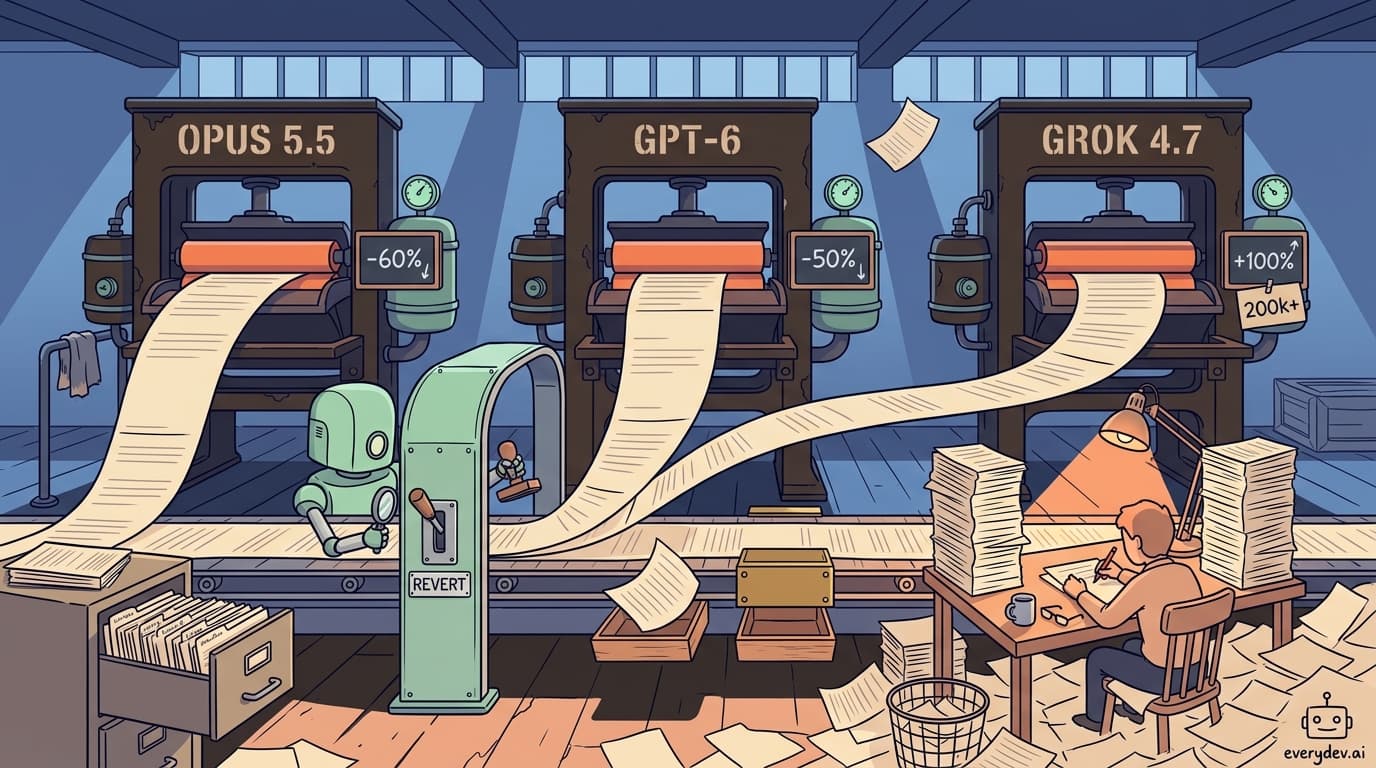
Anthropic cut cache reads by 60% and OpenAI halved its whole price list, both inside 36 hours. xAI read the same market and doubled its rate for long prompts. Writing code keeps getting cheaper; reviewing, deploying and remembering it is where the week's launches went.
Cursor released bots that watch production instead of pull requests, and published numbers on what an AI reviewer does to a review queue. A model that cannot even make a sentence started a ten-figure funding rumor. And the most upvoted developer idea this week was a request for the industry to slow down.
60%
off Claude cache reads
half
the GPT-5.6 price
20 hrs to 3
on a 200k-line audit
4.8 to 3.8 min
average code review
230ms
covers 95% of agent searches
2x
Grok's rate above 200k tokens
In Focus
Anthropic and OpenAI Cut Prices, xAI Raised Them for Long Prompts
Anthropic cut the price of cache reads on Claude Opus 5.5 by 60%, from $0.50 to $0.20 per million tokens. Cache reads are what an agent pays to reuse context it has already processed, so a session that keeps working over the same repository collects that discount on every turn. Reusing ten million cached tokens now costs $2 instead of $5. Anthropic puts the saving across a typical workload at 40%. (Anthropic)
Claude Opus 5.5, as Anthropic reports it
- Input and output - $4 and $20 per million tokens, from $5 and $25 on Opus 5
- Cache reads - $0.20 per million, from $0.50, the deepest of the three cuts
- Output speed - more than 30% faster than Opus 5
- Tester result - a 680,000-line migration in under a day, work Anthropic says would have taken a team weeks
- Tester result - a 200,000-line codebase audited and fixed in under three hours, against more than twenty for Opus 5
Sonnet 5.5 and Haiku 5.5 arrive within weeks. (Anthropic)
Claude Code then made Opus the default on Pro and Team Standard, replacing Sonnet, and raised the five-hour limits on paid plans. Subscribers get the expensive model without choosing it, which spends the price cut on volume instead of returning it. The reaction came fast, much of it people saying the $200 plan had displaced Codex for daily work. (Releasebot)
OpenAI came back on September 22 with GPT-6 Sol and GPT-6 Luna at half the cost of the 5.6 series, a saving OpenAI credits to improvements in caching and inference. Sol is the coding and agent model and reportedly makes about half as many mistakes as its predecessor while reaching Astra-level reliability. Luna takes clerical volume: summarizing documents, extracting fields, answering short questions. Neither model's per-token price appears in the announcement. (TechCrunch)
xAI went the other way. Grok 4.7 charges double for a prompt over 200k tokens, and its 500k context window is unchanged from Grok 4.6, so the model did not get roomier; the far end of the window got more expensive. Long-context agent work is the one job that cost more at the end of this week than at the start. (xAI)
Grok 4.7 pricing, per million tokens (input / cached input / output)
- Below 200k prompt tokens - $2 / $0.50 / $6, unchanged from Grok 4.6
- Above 200k prompt tokens - $4 / $1 / $12, a tier Grok 4.6 did not have
- Not disclosed - a parameter count for 4.7
xAI has published no benchmark claim putting 4.7 ahead of Claude or GPT-6. (xAI)
Copilot added it across Pro, Pro+, Max, Business and Enterprise on usage-based billing. (GitHub)
In Focus
Cursor Put Bots on Production Instead of Pull Requests
Cursor released two bots that never write a feature. Rollouts follows a change from pull request through deploy, compares post-deploy metrics against the pre-deploy baseline in Datadog, Grafana or Honeycomb, and catches a regression in one endpoint or region before a global alert would fire. Security Review scans every pull request for injection flaws, authorization gaps, committed secrets, unsafe deserialization and insecure infrastructure defaults, and attaches a one-click fix to each finding. (Cursor)
Neither can merge or revert by itself. Rollouts is configured to do one of three things: ping the author, pause a progressive rollout, or open a revert pull request that waits for approval. Cursor reports average review time dropping from 4.8 to 3.8 minutes and comment acceptance rising from 45-50% to 60-70%. Reviewers act on the bot's comments more often than they did. Both are Teams and Enterprise only. (Cursor)
In Focus
Four Companies Went After the Same Waste: Agents That Forget
Grok Build, xAI's terminal agent, now keeps notes between sessions. It writes conventions, decisions and project facts to markdown in the background, then reads them back before touching related code. /dream tidies the notes, /memory prints what it kept. No new model and no benchmark, just less context re-read at the start of every session. (Unite.AI)
LangChain attacked it from two sides. Deep Agents 0.8 gives an agent separate memory for the user and for itself, plus file APIs inside the sandbox. LangSmith Fine-Tuning feeds production traces back as training data, closing a loop most teams currently close by hand with a scraper and a folder of JSON. (Latent Space)
Perplexity built a search engine for machines. Fast Search runs on Photon, a new Rust retrieval and ranking service that returns 95% of results in 230ms or less, which puts a web search inside an agent's loop rather than in front of a person. Perplexity says a small team of engineers and hundreds of agents built it. (Perplexity)
AWS published a guide for teams that cannot send source to a vendor: point OpenCode at open-weight models on Bedrock, keep everything inside the account boundary, pay per token instead of per seat. It recommends routing routine generation to a cheap model and architecture or security questions to a stronger one. (AWS)
In Focus
A Model That Cannot Write Drew a Ten-Figure Rumor
TypeSafe calls Jev a System One model: it produces no text, and instead takes a set of options and returns a probability. It is a referee for the yes/no, multiple-choice and scoring calls buried inside an application, at far less than an LLM charges to do the same job slower. TypeSafe has not published a price. A week after launch, investors are reportedly lining up a round at a valuation with no relationship to the model's size. Skeptics point out, correctly, that this is a well-packaged classifier. (The Information)
In Focus
Xiaomi Gave Away the Training Environments, Not Just the Weights
Xiaomi open-sourced MiMo-V2.6 under MIT in two sizes with a 1M context window, and the Pro model took the top spot in the open-weight rankings on the Artificial Analysis index. Then it released the thing labs keep: several thousand reinforcement learning environments, plus the training code that used them. Weights let a team run what Xiaomi built. Environments let them train something Xiaomi did not. (TechNode)
StepFun's Step 5 Preview is a 600B mixture-of-experts model built to run for hours, with a 1M context window and pricing cheap enough to leave one working overnight. The API is live, weights are promised October 15. Two releases in one week aimed at agents that run for hours, one already free under MIT and one about to be. (StepFun)
In Focus
OpenAI Deleted a Working API, and Three Leaks Point at DevDay
The Videos API and every Sora 2 model went dark on September 24, six months after notice, with nothing to migrate to. Anyone still on it is rewriting against Veo, Kling, Seedance or open weights. OpenAI will retire a generative API outright rather than keep it running for the people who built on it. (OpenAI)
A leaked onboarding screen shows three API tiers, Free, Prototype from $5 and Accelerate from $50, covering API access, Codex and Playgrounds. Nothing in it promises application hosting. The internet decided it promised application hosting. (Progressive Robot)
A separate leak describes a $500-a-month ChatGPT Pro Max tier pitched as the fastest Work and Codex, sitting above the Pro plan that stopped taking new signups on September 10 when GPT-6 Astra demand overran capacity. Priced for somebody running Codex jobs from morning to night. DevDay on September 29 confirms or kills all three. (Startup Fortune)
In Focus
Meta, Google and Anthropic Rearranged Their Platforms
Meta made its Model API generally available worldwide at Connect, put out Muse Spark 1.3 for coding and agent work, and took Muse Code out of beta. Muse also picked up Mac control and a wearable called Muse Charm. General availability removes the waitlist. (Meta)
Google's Gemini 4 is in post-training, and DeepMind's Koray Kavukcuoglu says the company wants an early version out quickly. It already runs behind Antigravity internally, so Google's engineers are doing real work on it while everyone else waits for a release date. (9to5Google)
Anthropic pushed Claude Marketplace past two thousand connectors and folded in partner products built on Claude, from Cursor to Harvey to Lovable, plus consulting firms. Enterprises can pay through existing Anthropic spend commitments. Procurement is the channel, and procurement is hard to rip out. (RuntimeWire)
In Focus
Phone and Voice Agents Picked Up Real Constraints
Alibaba launched Qwen Intelligence, three agents built for handsets. A Planner decomposes the task, a Mobile-Use agent works across applications by calling APIs first and tapping the screen only when there is no API, and a Creative agent handles images. Alibaba also published four benchmarks covering planning, cross-application work, real devices and safety. Honor's Magic9 ships it first. (Alizila)
Google's Gemini 3.8 Flash TTS and Flash-Lite TTS take a written description of a voice, then take line-by-line direction on pacing, dialect and delivery. Flash-Lite is the cheap tier for dubbing and voice agents. Flash clones an authorized voice from a thirty-second sample, gated behind a consent recording and watermarked on every clip. Consent is an input the API requires, not a paragraph in a policy. (Google)
ChatGPT Voice gained plugins and Work access, so email, calendar and Slack are reachable mid-conversation, the model behind Voice can be set to Astra, Sol or Luna, and document and spreadsheet tasks can start from speech. (OpenAI)
In Focus
Attack Costs Fell for Everybody, Defense Costs Fell for Some
The Hacktron researchers who chained two bugs into OpenAI's internal repository using Claude gave an interview arguing the whole industry is exposed. Their argument is about price, not vulnerabilities. Serious offensive work used to require a rare skill set and weeks of effort. It requires a subscription and an afternoon. (Washington Post)
Fortune reports OpenAI may preview GPT-6 Cyber at DevDay, a security-focused model paired with tooling to deploy it safely. Google, OpenAI and Anthropic are separately planning a voluntary standards body, tentatively the Frontier AI Standards Agency, pencilled in for late 2026 or 2027 with no government role in the design. (Gizmodo)
Self-governance is a defensible starting position and also precisely what three companies would pick if the goal were setting the terms before a regulator does. (AI Weekly)
Signals
Signals from the Edges
Transformers reads GGUF files directly
GGUF is the quantized model format llama.cpp uses, and Hugging Face can now load those files into Transformers without conversion, and on Apple Silicon the speeds come close to llama.cpp itself. Fine-tuning directly on a quantized model becomes possible.
Claude agents flagged a CRISPR-like enzyme system
Roughly 950 agents screened more than 200,000 enzymes in 21 hours and found a system Anthropic named ART, carrying a repeat pattern resembling CRISPR. What it does is unknown. Treat it as a story about compressing a literature search, not a gene-editing result.
Google puts TPUs in orbit on October 1
A fridge-sized satellite carrying four TPUs goes up on a SpaceX rideshare to test whether AI chips survive radiation and thermal cycling, where solar panels collect far more power. The chips run about fifteen minutes before they need to cool down.
Investors are funding research labs with no product
The FT digs into the startups raising enormous rounds before revenue or customers exist, a category the piece calls neolabs.
Meta added text-to-game tools
Horizon Create and Horizon Studio build 2D and 3D mobile games from text prompts, on a phone or in a browser.
A top r/webdev thread is about burning out on the pace
The question was how anyone stays calm with this much shipping. The replies converge: the tools did not reduce the work, they raised the expected output.
Watch: The Dark Arts of Skill Engineering
Paul Bakaus of Impeccable on writing agent skills that survive contact with a real codebase, well timed given that Claude, Grok Build and LangChain all put out agents that remember.
Listen: Who feeds the GPUs?
VAST Data CEO Renen Hallak on the storage layer under AI, from KV caches to agent memory to confidential compute with NVIDIA. If cheaper cache reads paid for the price cuts up top, this is the layer they came out of.
Looking Ahead
What to Watch
- 1
DevDay on September 29
Three leaks point at it: the API tiers, the Pro Max plan and a security model. Whether OpenAI also announces application hosting is the one thing the leaked screen left blank.
- 2
Step 5's weights on October 15
A 600B mixture-of-experts model built for long jobs, released openly, would drop directly onto a ranking Xiaomi just took. The paid API is the audition.
- 3
Sonnet 5.5 and Haiku 5.5
Opus became the default on paid Claude Code plans. The cheaper models arriving next decide whether that default holds or whether Anthropic quietly walks it back on cost.
- 4
Gemini 4 shipping early
It already runs behind Antigravity internally and Google has said it wants something out fast. A model released under competitive pressure is a different artifact from a finished one.
- 5
A second System One model
Jev's valuation rests on a category claim. The test is not a benchmark. It is whether a rival ships one and whether anybody puts it in a hot path.
- 6
Project Suncatcher's launch
Four TPUs, fifteen minutes of compute, then a cooldown. Orbital data centers are years out, but radiation and thermal data comes back in weeks.
Cheaper tokens mean more pull requests, more reviews, more rollouts, more reverts, all arriving in the same inbox. Cursor measured that and sold the fix: one minute off each review.