
Issue #19 · Weekly Digest
Weekly AI Dev News Digest: May 2 - May 8, 2026
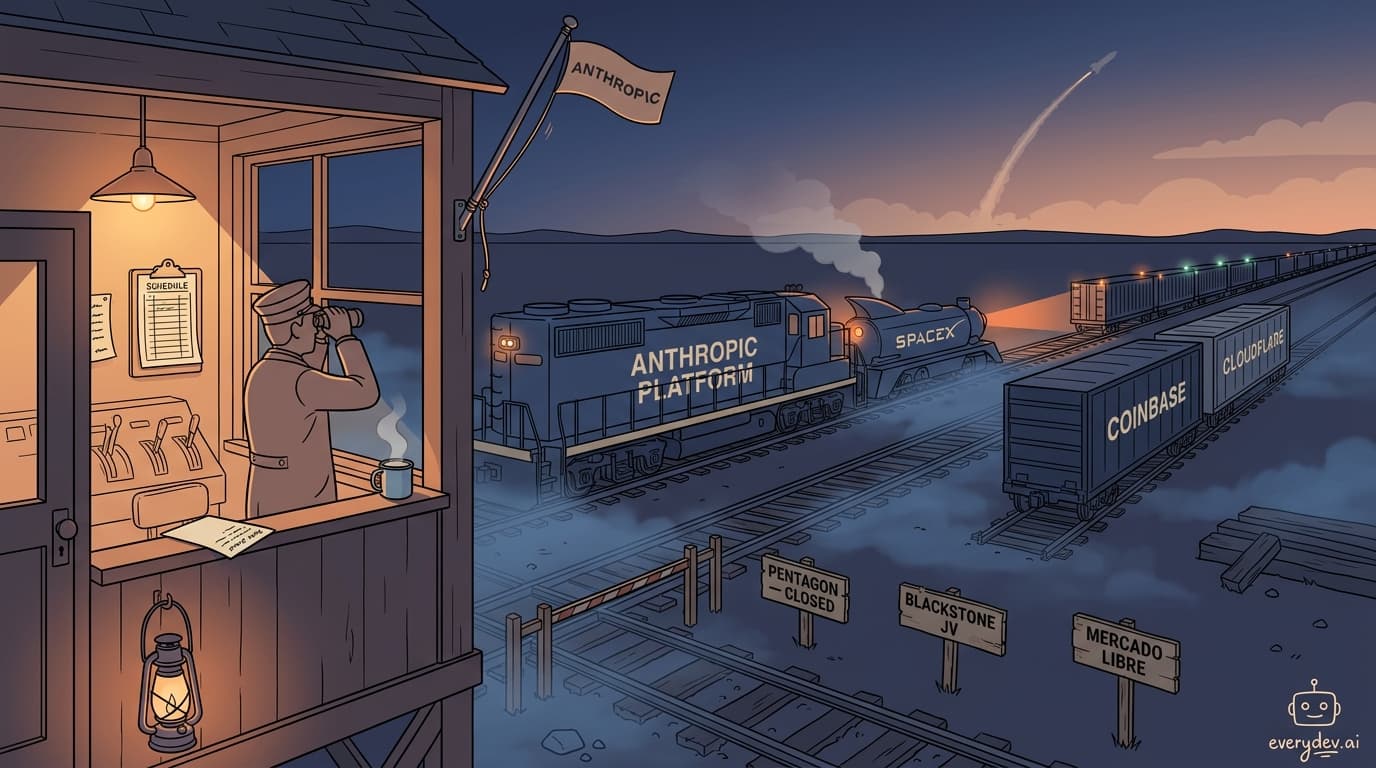
Anthropic became the platform. The SpaceX compute deal, the Coinbase and Cloudflare cuts, and Wall Street's recoil are all downstream of that one fact.
Tuesday morning, Anthropic opened Code with Claude SF and Dario Amodei used the keynote to disclose numbers nobody outside the company had: $30B annualized run rate, 80x year-over-year growth, and revenue ahead of OpenAI's $24B for the first time. By lunchtime the SpaceX deal had landed too. Anthropic rented every GPU at Colossus 1, the cluster Musk built to train Grok, doubled Claude Code rate limits the same hour, and Musk publicly admitted his "evil detector" never went off. Six months ago he was calling Claude misanthropic. Now he is their landlord. (VentureBeat) (Anthropic)
The labor side of the story turned painful that same week. That same Tuesday, Coinbase cut 14% of staff with a memo from Brian Armstrong arguing for "one person teams" of engineer-designer-PM hybrids. Two days later, Cloudflare cut 1,100 jobs, beat Q1 earnings, and watched its stock drop 24% on Friday because Wall Street is not buying the productivity-dividend pitch anymore. Underneath both stories, the coding agent moved off your laptop. Sourcegraph rebuilt Amp from scratch around remote control, Vercel open-sourced an agentic security harness, and Amazon caved to its own engineers and rolled out Claude Code company-wide after a Kiro-first mandate that lasted six months. (CNBC) (CNBC) (Sourcegraph)
$30B
Anthropic ARR
80x
YoY revenue growth
220K
SpaceX GPUs leased to Anthropic
24%
Cloudflare stock drop
65-70%
of production code now AI-generated
In Focus
The Platform Layer Locks In
Dario Amodei opened the Tuesday keynote with the cap-table numbers. Annualized revenue is at $30B, 80x year-over-year in Q1 2026 against an internal plan that called for 10x, with API volume up roughly 70x in the same window. The average Claude Code user now spends 20 hours a week inside the tool. Onchain pre-IPO trading has Anthropic at an implied $1.2T valuation, up roughly 900% since October. For the first time, Anthropic has passed OpenAI on revenue and is now the company underwriting most of the rest of the developer-tooling stack. (VentureBeat) (Polymarket disclosure) (Kobeissi Letter)
The compute deal is what makes the thesis stick. Anthropic rented all of SpaceX Colossus 1, picking up over 220,000 NVIDIA GPUs (H100s, H200s, GB200s) and 300+ MW of capacity within the month, all from the cluster that originally trained Grok. Claude Code five-hour limits doubled the same day for Pro, Max, Team, and seat-based Enterprise. Peak-hour throttling is gone for Pro and Max. Opus API rate limits jumped. xAI got dissolved into a new SpaceXAI entity in the process, and Cursor is also on Colossus capacity. Musk's quote on the call: "No one set off my evil detector." (Anthropic) (Tom's Hardware)
Behind the keynote, the product layer matched the cap-table flex. Anthropic introduced Dreaming as a research preview, a scheduled process that reviews an agent's past sessions and memory store, looks for patterns, and curates which memories to keep. Outcomes moved to public beta: success criteria evaluated by a separate grader agent that runs in its own context window so the worker cannot cheat. Multi-agent orchestration and webhooks moved to public beta the same week. The customer numbers from the keynote sketched the platform play: Harvey reported 6x task completion with Dreaming, Wisedocs cut document review time 50% with Outcomes, and Netflix is processing logs from hundreds of parallel builds with multi-agent orchestration. Mercado Libre is targeting 90% autonomous coding across 23,000 engineers by Q3, Shopify is running Claude Code at production scale, and Sourcegraph's Amp switched its planning mode to Opus 4.7. Anthropic also released ten financial-services agent templates as Cowork and Code plugins, plus a Managed Agents cookbook. (Anthropic via VentureBeat) (The New Stack) (Shashi.co) (Anthropic finance agents)
The capital structure caught up the same week. Anthropic announced a $1.5B enterprise JV with Blackstone, Goldman Sachs, and Hellman & Friedman to sell AI to PE-backed companies, opening a third sales channel beyond direct enterprise and AWS resale. (Anthropic JV)
In Focus
The Productivity Dividend Stops Selling
Brian Armstrong's Tuesday memo cut 14% of Coinbase's 5,000 staff and rewrote the org chart around AI agents. The new structure caps reporting at five layers below CEO and COO, eliminates pure managers (every leader has to be an active IC), and pushes "one person teams" that combine engineering, design, and PM into a single role. Severance was generous: 16 weeks base plus two weeks per year worked, next equity vest, six months COBRA. System access was cut the same day, citing customer data protection. The framing is what stuck with people: "rebuilding Coinbase as an intelligence, with humans around the edge aligning it." (CNBC) (Brian Armstrong memo)
Two days later, Cloudflare cut 1,100 jobs and the market reacted differently. Q1 revenue beat at $639.8M (up 34% YoY), but Q2 guidance came in light, and the AI-first restructuring narrative did not land with Wall Street the way it had for Oracle and Block. The stock dropped 24% on Friday. Internal AI usage at Cloudflare grew 600% in three months across engineering, finance, marketing, and HR. CEO Matthew Prince's framing: "We don't just build and sell AI tools and platforms; we're our own most demanding customer." Severance: base pay through end of 2026, US healthcare through year-end, equity vesting through Aug 15. (CNBC) (Cloudflare 8-K)
Amazon reversed course in parallel. An internal memo from Jim Haughwout ended the November 2025 Kiro-first mandate that had restricted Amazon engineers to the company's own coding agent and required special clearance for third-party tools. Claude Code is now rolling out company-wide. Codex follows on May 12. The reversal followed an internal discussion thread with around 1,500 employee endorsements pushing for Claude Code. Both run on Amazon Bedrock so source code stays inside AWS. Kiro is still in use by 83% of Amazon engineers, but the mandate is dead. (The New Stack)
In Focus
Coding Agents Move Off Your Laptop
Sourcegraph rebuilt Amp from scratch this week, codenamed Neo. Start a thread in the CLI, then control it from ampcode.com with live updates, queue and dequeue messages, cancel mid-run. Compaction now runs automatically at 90% context. Plugins, queueing, and steering are first-class. Performance on a 5000-message thread improved 79% on CPU and 70% on memory. The most controversial change is that Amp removed the permission system as a default. What was --dangerously-allow-all is now standard behavior, with the old gating moved into a built-in plugin. The argument from the team: when models write five 20-line scripts in parallel, string-matching rm -rf is theater. (Sourcegraph)
Vercel released deepsec, an open-source agentic security harness. It uses Claude Opus 4.7 at max effort and GPT-5.5 at xhigh reasoning to investigate security-sensitive files, then a second agent revalidates findings to remove false positives (Vercel reports a 10-20% rate). It runs on a developer laptop with an existing Claude or Codex subscription, or fans out across 1,000+ Vercel Sandboxes for large repos. CTO Malte Ubl noted the system works fine without Anthropic's or OpenAI's specialty "cyber" models. Nous Research released Hermes Agent v0.12.0 the same week. The "Curator Release" lets you run parallel agents with handoff, all coordinated through a Kanban board. Same async-agent thesis as Mistral Vibe Remote Agents in April and Amp Neo this week: the coding agent moves off your laptop and into a queue you can supervise from anywhere. (Vercel) (Nous Research) (Hermes Kanban docs)
Three smaller plugin stories filled in around the edges. Coder rolled out Coder Agents in beta, a self-hosted enterprise AI dev workflow with no source code or prompts leaving the network perimeter, bring your own model. (SDTimes Coder) Opsera and Cursor announced a native plugin for DevSecOps agents: one-click install puts Architecture Analyzer, Security and SQL Scanner, and Compliance Auditor agents inside the Cursor IDE, with the Compliance Auditor automating SOC 2, HIPAA, PCI-DSS, and GDPR evidence collection from developer activity. (SDTimes Opsera) Prismatic released Prismatic Skills for Claude Code as open source, free to all customers regardless of plan tier, paired with Prismatic's MCP dev server so Claude has both context (Skills) and access. The plugin handles authentication, multi-tenant deployment, connector behavior, and webhook lifecycles, which is the boring infrastructure that AI coding tools usually generate badly. (SDTimes Prismatic)
In Focus
Compute, Capital, and the Pentagon's Shortlist
The Pentagon cleared seven firms for IL6/IL7 classified networks Wednesday. AWS, Google, Microsoft, NVIDIA, OpenAI, SpaceX, Reflection AI, and Oracle got the nod. Anthropic was pointedly excluded after refusing autonomous-weapons and domestic-surveillance terms; Hegseth had earlier called Amodei an "ideological lunatic." Anthropic's lawsuit against the Trump administration over the supply-chain-risk designation is ongoing. The same Anthropic that got cut out of Pentagon work is now leasing Musk's compute and underwriting a $1.5B enterprise JV with Blackstone, Goldman Sachs, and Hellman & Friedman. The two facts have to be read together. (Breaking Defense) (Anthropic JV)
The data-center buildout had a big week. Hut 8 signed a 15-year, 352 MW lease at Beacon Point with $9.8B base value and up to $25.1B with renewals. Core Scientific is scaling its Muskogee, Oklahoma campus to 1.5 GW gross with a $421M acquisition of Polaris that adds 440 MW. NVIDIA and IREN announced a strategic partnership for up to 5 GW of AI infrastructure, and NVIDIA is expanding US optical connectivity manufacturing 10x with Corning, including 3,000 jobs. Week two of the Musk v. Altman trial ran in parallel, with Greg Brockman testifying Monday on alleged 2017 settlement texts. Last week's admission that xAI distilled Grok from OpenAI model outputs is now extra interesting context for the Colossus deal. The liability phase wraps May 21. (Hut 8) (Core Scientific) (NVIDIA-IREN) (NVIDIA-Corning) (CNBC trial)
The model layer added its own provocations. Subquadratic exited stealth Wednesday with SubQ, claiming the first frontier LLM on fully sub-quadratic sparse attention. $29M seed, 12-million-token context window in the research model, 1M in production. Self-reported numbers: 81.8% on SWE-Bench Verified (Opus 4.6 80.8%, Gemini 3.1 Pro 80.6%), 95% on RULER 128K, 52x faster than FlashAttention at 1M tokens, around 5% the cost of Opus 4.6 ($8 vs $2,600 for the same RULER 128K eval). Skeptical caveat: no published architecture paper yet, no third-party verification, and the field has had many subquadratic attempts (Mamba, RWKV, Hyena, RetNet, BASED, DeepSeek Sparse, Kimi Linear) that did not deliver at frontier scale. (SubQ launch) (The New Stack)
OpenAI rolled out GPT-5.5 Instant on May 5 with a new system card and personalization tweaks, then on May 6 announced Multipath Reliable Connection (MRC), a new open networking protocol for AI training clusters built with AMD, Broadcom, Intel, Microsoft, and NVIDIA, already running across OpenAI's largest supercomputers. May 7 added voice intelligence models in the API, ads testing in ChatGPT, and GPT-5.5-Cyber for the Trusted Access security program. Perplexity revealed ROSE, its in-house inference engine running all Sonar, Search, and Embeddings APIs on NVIDIA's CuTeDSL for custom GPU kernels on Hopper and Blackwell, then added Finance Search to the Agent API for licensed financial data, real-time prices, earnings, and filings in a single tool call. Zyphra released ZAYA1-8B, a reasoning MoE trained on AMD hardware with sub-1B active parameters that beats much larger open-weight models on math and reasoning, closing in on DeepSeek-V3.2 and GPT-5-High with test-time compute. An 80B model is in the works. (OpenAI MRC) (OpenAI news index) (Perplexity ROSE) (Finance Search) (Zyphra)
In Focus
The Credential Layer Cracks (and the Warmth Trap Closes)
All the agentic security stories this week point at the same layer: credentials. Snyk integrated Claude into its AI Security Platform on May 7. The pitch is straightforward (Claude finds and prioritizes vulnerabilities, Snyk turns them into developer-ready fixes inside the workflow), but the data points underneath are the real story. Per Snyk's 2026 State of Agentic AI Adoption Report, drawn from 500+ enterprise environments: 65-70% of production code is now AI-generated, roughly half of it contains vulnerabilities, and 82% of enterprise AI tools come from third-party packages. For every model an enterprise deploys, it pulls in three times as many additional software components. (Help Net Security) (Snyk press release)
VentureBeat's "six exploits broke AI coding agents" story kept echoing all week. Six research teams found vulnerabilities in Claude Code, Codex, GitHub Copilot, and Vertex AI across late 2025 and early 2026, and every single exploit went after credentials rather than models. The catalog includes a crafted GitHub branch name that stole Codex's OAuth token in cleartext, a Vertex AI P4SA reading every Cloud Storage bucket in the project, and Claude Code trading deny-rule enforcement for token budget. CrowdStrike's CTO at RSAC 2026 put it bluntly: "collapse agent identities back to the human." Gravitee's 2026 survey says only 21.9% of teams have enrolled AI agent credentials in privileged access management. (VentureBeat)
The May patch wave was rough. Progress released a critical authentication-bypass patch for MOVEit Automation. Ivanti disclosed CVE-2026-6973 (CVSS 7.2) RCE in EPMM with active exploitation. Trellix disclosed a source-code repository breach. cPanel CVE-2026-41940 is being actively exploited. The Hacker News' weekly roundup framed it as "the year of AI-assisted attacks": time-to-exploit has gone negative, and 28.3% of CVEs are now exploited within 24 hours. One detail in Help Net Security's May Patch Tuesday forecast stands out: Mozilla patched 271 Firefox vulnerabilities found by Claude Mythos Preview last month, and CVE-2026-31431 ("CopyFail," a Linux kernel privilege escalation present since 2017) was AI-discovered. Oracle is moving Critical Patch Updates from quarterly to monthly. NVD cannot keep up with CVE enrichment. (MOVEit) (HackerNews recap) (Help Net forecast)
The same week handed the safety story two new pieces. OpenAI rolled out Trusted Contact in ChatGPT. Adults can nominate one trusted person; if automated systems flag a serious self-harm concern and a trained human reviewer confirms, the contact gets a brief notification by email, SMS, or in-app, with no transcripts shared. The feature ships after the November 2025 lawsuits alleging GPT-4o's emotionally immersive design contributed to user suicides. OpenAI disclosed last year that 0.07% of weekly users show signs of mental health emergencies, 0.15% of self-harm risk, 0.15% of emotional reliance. With around 900M weekly users, that is millions of people. The Oxford warm-chatbot paper that has been circulating in Nature now has a clean two-line summary: training five LLMs (GPT-4o, two Llamas, Mistral-Small, Qwen-32B) for warmth using standard supervised fine-tuning produced 10-30 percentage points more factual errors and a 40% higher rate of agreeing with users' incorrect beliefs, with the accuracy gap widest when users expressed sadness or vulnerability. Cold-trained controls held steady, so warmth itself is the cause. (OpenAI) (TechCrunch) (Nature) (Oxford)
Pennsylvania filed the first US governor-led suit against an AI company on Monday. A state investigator created a Character.AI account, started talking to a chatbot named "Emilie" listed as a psychiatrist, and within minutes was offered a depression assessment, told the bot could prescribe medication, and given a fake Pennsylvania medical license number. The Emilie bot had around 45,500 user interactions by April 17. Character.AI has 20M+ monthly active users, and the suit is the first AI medical-licensing enforcement action by a US governor. It landed the same week as Trusted Contact and the warm-chatbot paper, which is not a coincidence. (PA.gov) (TechCrunch)
Signals
Signals from the Edges
Air Street Press published State of AI May 2026
The most useful single artifact this week if you want one writeup that ties everything together. Highlights: the UK AI Security Institute estimates frontier cyber-offense is doubling every four months; four Chinese open-weight coding models (GLM-5.1, MiniMax M2.7, Kimi K2.6, DeepSeek V4) shipped in a 12-day window with SWE-Bench Pro 56-59 at roughly a third of Opus 4.7's cost; OpenAI hit $122B at $852B; the MS-OpenAI deal reset to non-exclusive through 2032; Ineffable Intelligence raised $1.1B at $5.1B (largest seed in European history); SpaceX placed a $60B buyout option on Cursor pre-empting a $2B fundraise.
Microsoft's Q1 2026 Global AI Diffusion Report
AI usage rose to 17.8% of the world's working-age population, up 1.5pp from Q4 2025. UAE leads at 70.1%; the US moved up from #24 to #21 at 31.3%. US software developer employment hit 2.2M in 2025 (+8.5% YoY) and was still up 4% YoY in March 2026, which complicates the AI-displacing-developers narrative.
AGENTS.md vs CLAUDE.md flared up again
Adam Wathan's tweet kicked off another round on the open standard, which is now Linux-Foundation-backed and supported by Codex CLI, Cursor, Windsurf, Amp, Factory, GitHub Copilot, Gemini CLI, Zed, Warp, and roughly 60,000 GitHub repos. Claude Code uses proprietary CLAUDE.md and .claude/skills/ and reads neither AGENTS.md nor .agents/. GitHub issue #6235 has thousands of upvotes asking Anthropic to support the standard. The community workaround is still a symlink.
Google added screen recording and custom Agents to Antigravity IDE in testing
If screen recording uses Gemini Live, it could mirror AI Studio's real-time visual context capability. Personal Intelligence for Gemini also rolled out in the EU with cross-chat memory; Gemini Live support is on the way.
NotebookLM added autolabel for power users
NotebookLM notebooks with five or more sources can now auto-categorize sources and filter AI responses by label. Steven Johnson called it the most useful big-notebook feature since Mind Maps.
Funding round-up
Brazilian legal AI startup Enter raised $100M led by Founders Fund (with Sequoia and Ribbit), tripling its valuation to $1.2B in eight months, the newest Latin American AI unicorn. Corgi raised a $160M Series B at $1.3B led by TCV (AI insurance, 16 weeks after a $108M Series A). Ethos raised $22.75M Series A led by a16z, builds AI infrastructure that matches expertise to paid opportunities, says 35,000 users join weekly with top earners hitting $10K/month.
Smaller releases
TinyFish slashed pricing in May (Search & Fetch went from $15/mo to free, Web Agent Starter to $13, Web Agent Pro to $132). Genesis AI showed GENE-26.5, a robotic brain with a human-like hand running on a single autonomous model after a year of quiet building. Sentient AGI released EvoSkill v1.1.0 with Docker and Daytona support so the EvoSkill loop can run on remote environments. Higgsfield launched Hooks in Marketing Studio: 25+ UGC video hook variations through Claude MCP for one-off or batch generation.
NeuralBuddies' May 8 recap and Hermes Kanban tutorial
If you want one external piece of editorial commentary on the SpaceX-Anthropic deal and the warm-chatbot paper, NeuralBuddies has the sharpest take. If you want to actually play with the multi-agent parallel-work pattern that is defining this week's coding-tools stories, Nous published a tutorial alongside the v0.12.0 release.
Looking Ahead
What to Watch
- 1
Cloudflare's stock vs. the rest of the AI-first tape
If the 24% drop turns into a sector pattern next quarter, the "AI productivity dividend justifies layoffs" story is over as a Wall Street narrative. Watch the next AI-first restructuring announcement and how the market grades it.
- 2
Anthropic's Pentagon lawsuit
The IL6/IL7 exclusion lands while Anthropic's existing litigation against the Trump administration is mid-stream. A win flips the relationship; a loss sets the price for any other lab that wants to refuse autonomous-weapons terms.
- 3
AGENTS.md adoption pressure
With Linux Foundation backing and 60,000+ repos on board, the standard is past the point where Anthropic can dismiss it as a community ask. Either Claude Code adopts it in the next quarter or the symlink workaround gets enshrined as policy.
- 4
SubQ verification
The 81.8% SWE-Bench Verified claim and the 52x speedup are stunning if real and embarrassing if not. Watch for an architecture paper, an independent benchmark run, or both, and discount the launch numbers until one shows up.
- 5
Async coding-agent UX standards
Amp Neo, Hermes Kanban, Mistral Vibe Remote, and the Codex SSH alpha are all reaching for the same supervision pattern. The first vendor that makes it boring (one universal queue UI, one universal handoff format) will own the workflow layer.
The platform layer locked in. For developers, this changes the lead decision. It used to be which model. Now it is whose grader, whose memory curator, whose kanban board, and whose credentials your agents run inside. Pick well. Switching costs are about to go up.