
Issue #20 · Weekly Digest
Weekly AI Dev News Digest: May 9 - May 15, 2026
Three of the four frontier AI labs now have SpaceX somewhere on their compute critical path, and the company that built the most-used AI coding tool is being absorbed into the empire. The off-ramps are getting harder to find.
The acquisition path is winning. SpaceX holds the option on Cursor until year-end, and the meetings happening this week are the kind that come right before a close, not the kind that happen during a partnership. Any developer with Cursor in their daily toolchain is downstream of a Musk decision now.
OpenAI and Anthropic spent Wednesday trading pricing levers. Notion spent the same day building a layer above them. Underneath the IDE drama, the npm supply chain caught fire in a way nobody had documented before, Google reported what looks like the AI-vulnerability-race milestone people had been watching for, and two of the biggest distribution platforms cut headcount under the now-familiar "we're restructuring for AI" framing. Lot to get through.
$60B
SpaceX option on Cursor
84
malicious npm packages with valid provenance
50%
Claude Code weekly limit raise
$4B
OpenAI DeployCo seed
224B
Hermes Agent daily tokens
In Focus
The fight for the IDE
On Friday, The Information reported that Anysphere staff had begun visiting xAI offices to interview xAI staff about their ongoing projects (The Information). SpaceX has held an option since April 21 to either acquire Anysphere for $60B by year-end or pay $10B for joint work (SpaceX). Those interviews look like the ones that happen before an acquisition closes.
The fuller backdrop: xAI was folded into SpaceX after the February 2026 merger, only two of xAI's original eleven co-founders remain, two senior Cursor engineering leaders left for xAI in March, and xAI has been renting Colossus compute to Cursor to train Cursor's own model. xAI's internal coding tool Macrohard has reportedly been failing against Claude Code and Codex, so the integration runs in only one direction. Cursor hit ~$2B ARR by February, doubling in three months, and remained the most-used AI coding tool among individual developers (TechCrunch). Its inference backbone is still Claude and GPT, which means today's Cursor sells access to the models made by the two companies competing hardest against it. The SpaceX deal is partly the escape route, eventually onto Colossus and Grok.
OpenAI fired first on Wednesday. Sam Altman, 11:13 AM PT: "codex is the best AI coding product and we want to make it easy to try. for the next 30 days, we are giving companies that want to try switching over two months of free codex usage" (Sam Altman) (OpenAI). The Claude Code team landed its answer by end of day: weekly limits up 50% through July 13, auto-applied to all Pro, Max, Team, and seat-based Enterprise users.
That is Anthropic's third Claude Code limit raise in two weeks. April 28 removed peak-hour throttling. May 6 doubled per-window limits alongside the SpaceX news. May 13 raised weekly limits another 50%. The strategic split: Codex aims its incentive at companies migrating off competitors, Claude Code raises ceilings for individual Pro and Max accounts. Same battlefield, different segments. One caveat. A GitHub issue posted May 12 reports that the May 6 per-window doubling came with weekly-budget rebalancing that some Pro users experience as a net cut, with sessions consuming ~21% of weekly limit instead of ~12%. The May 13 raise may be partly damage control. (GitHub issue #58557)
Notion landed the third move on May 13 by becoming neutral ground. The Notion Developer Platform shipped five pieces at once: a CLI (ntn), Workers (hosted code sandboxes), database sync, an External Agent API, and webhook triggers. Launch partners on the External Agent API: Claude Code, Cursor, Codex, Decagon. Notion gets to be the orchestration layer where developers swap between any of the four agents otherwise fighting each other this week, without leaving the workspace. Workers free during beta, switching to a credit model on August 11. Users have built over a million Custom Agents since that feature shipped in February. (Notion)
In Focus
A worm with valid provenance
The TanStack worm is the dev-relevant story of the week and probably of the year so far. On May 11 between 19:20 and 19:26 UTC, 84 malicious versions were published across 42 @tanstack/* packages, including @tanstack/react-router at roughly 12.7M weekly downloads. The compromise was detected within 20 minutes by StepSecurity's ashishkurmi. CVE-2026-45321, CVSS 9.6. (TanStack postmortem)
The attack chain stitched together three GitHub Actions vulnerabilities: a pull_request_target "Pwn Request," Actions cache poisoning across the fork/base trust boundary, and OIDC token extraction from runner process memory. No npm tokens were stolen. The attacker hijacked TanStack's legitimate OIDC trusted-publisher binding from inside a running CI job and shipped packages signed by TanStack itself. The first documented case of malicious npm packages carrying valid SLSA provenance.
And it propagates. The payload steals GitHub, npm, AWS (via IMDSv2), GCP, Azure, Kubernetes, and Vault tokens, then auto-publishes itself to any package the victim has publish access to. By end of day, 169 npm packages and 2 PyPI packages were affected (373 malicious package-version entries), including @mistralai/mistralai (Mistral's TypeScript client), the mistralai and guardrails-ai PyPI packages, @uipath/*, @squawk/*, and intercom-client (StepSecurity). A persistent daemon called gh-token-monitor polls every 60 seconds. Microsoft's analysis of the PyPI Mistral payload found country-aware logic with a "1-in-6 chance of rm -rf / when the system appears to be in Israel or Iran." Triple-channel exfiltration: typosquat git-tanstack[.]com, the Session messenger network, and GitHub API dead drops. StepSecurity attributes the campaign to TeamPCP, the same group behind the March Trivy and April Bitwarden CLI compromises.
Three smaller security stories landed the same week. On May 9, BleepingComputer published research from HiddenLayer on a fake OpenAI repository on Hugging Face (Open-OSS/privacy-filter) that typosquatted OpenAI's legitimate Privacy Filter and pushed a Rust-based infostealer via a PowerShell loader (BleepingComputer). On May 11, Google's Threat Intelligence Group reported the first AI-built zero-day caught in the wild, a 2FA bypass in an unnamed open-source web admin platform, with telltale LLM artifacts including educational docstrings and a hallucinated CVSS score (Google TIG). John Hultquist of GTIG put it cleanly: "There's a misconception that the AI vulnerability race is imminent. The reality is that it's already begun."
OpenAI launched Daybreak on May 11, a cybersecurity initiative built on GPT-5.5, GPT-5.5 with Trusted Access for Cyber, GPT-5.5-Cyber, and Codex's agentic harness. Partners: Cloudflare, Cisco, CrowdStrike, Palo Alto Networks, Akamai, Fortinet, Oracle, Zscaler (Engadget). Direct response to Anthropic's Mythos and Project Glasswing. Daniel Stenberg, cURL's maintainer, was less impressed by Mythos. His verdict on The Register the same day: "greatest marketing stunt ever," after Mythos found one low-severity flaw in cURL (The Register). Two more dev-facing footnotes: cookie thieves were caught wrapping fake Claude Code installers with payloads that bypass Chrome's app-bound encryption via a new IElevator2 COM interface (The Register), and on May 13 the EU Commission confirmed OpenAI has agreed to provide GPT-5.5-Cyber access to EU cyber defenders for regulator evaluation; Anthropic has not made a similar Mythos offer.
In Focus
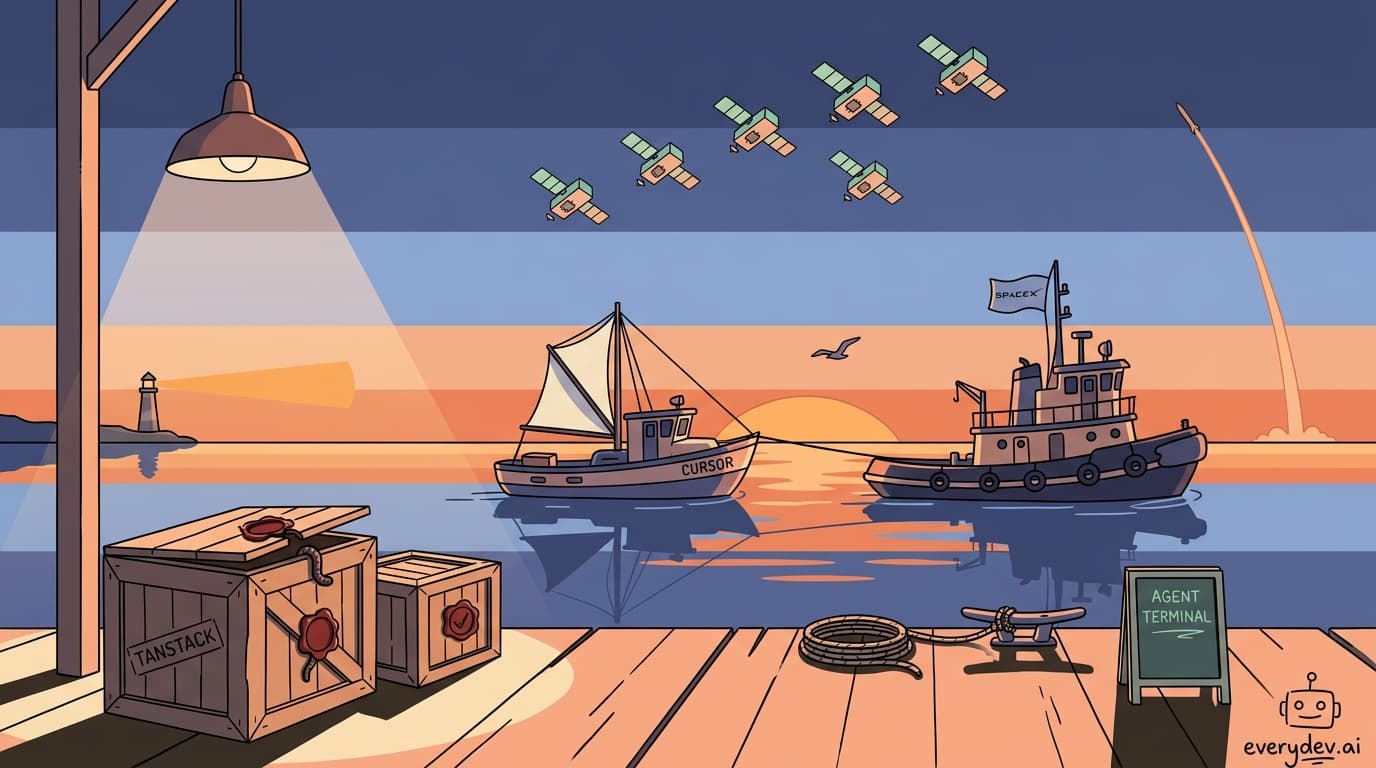
SpaceX is on three compute critical paths
Three of this week's biggest infrastructure stories share one company.
The Wall Street Journal reported on May 12 that Google is in talks with SpaceX about launch services for Project Suncatcher, Google's orbital data center initiative announced in November 2025 (TechCrunch). Initial plan: two prototype satellites in 2027, scaling to 81 TPU-carrying satellites in a 1km cluster, built by Planet Labs. The physics gives roughly 8x more solar capture than terrestrial panels in sun-synchronous orbit. The economics do not yet. Suncatcher needs ~$200/kg launch costs to make sense, SpaceX rideshare is currently $7,000/kg. Falcon 9 reusability is closing the gap but slowly. Altman has previously called orbital data centers "ridiculous for now."
That story stacks on Anthropic's recently signed deal for full Colossus 1 capacity in Tennessee (~300MW per FT), the SpaceX filing for up to 1M satellites tied to orbital data center ambitions, and the ongoing Cursor-xAI integration. Anthropic runs on Colossus. Cursor is heading for Colossus and Grok. Google may need Falcon 9 to launch Suncatcher. The SpaceX IPO is expected at $1.5–1.75T later in 2026, and three of four frontier AI labs now have Musk somewhere on their compute critical path.
In Focus
Where the agents get sold
Claude Platform on AWS hit GA on May 12 (Anthropic). AWS becomes the first cloud provider with full native Claude API access (Claude Managed Agents, advisor tool, web search/fetch, MCP connector, Agent Skills, code execution, files API) routed through an AWS account with IAM, CloudTrail, and a single AWS bill. Anthropic still operates the platform and data is processed outside the AWS boundary, so it complements Bedrock rather than replacing it. 17 regions. Same pricing as the native Claude API. PrivateLink supported. Anyone with existing AWS commitments now has the procurement-friendly Claude story they were waiting for.
OpenAI Deployment Company (DeployCo) launched on May 11 with a $4B initial investment at a $10B valuation (OpenAI). Majority-owned OpenAI subsidiary, 19 backers including TPG (lead), Advent, Bain, Brookfield, SoftBank, McKinsey, Capgemini, Goldman Sachs, Warburg Pincus. The first acquisition: UK firm Tomoro, ~150 forward-deployed engineers with clients including Tesco, Virgin Atlantic, Supercell, Mattel, and Red Bull. It is the Palantir playbook: embed engineers, charge for outcomes. The PE backers reportedly secured a 17.5% guaranteed annual return over five years (per TNW), unusual in venture. Pairs with the Anthropic enterprise services company announced a few days earlier with Blackstone, Hellman & Friedman, and Goldman Sachs.
SAP doubled n8n's valuation to $5.2B on May 12 and embedded the workflow platform inside Joule Studio. SAP simultaneously announced new strategic partnerships with Anthropic, AWS, Google Cloud, Microsoft, Mistral, Cohere, NVIDIA, and Parloa. The honeymoon ends when SAP picks favorites. For now, every major AI vendor gets table service. Cursor announced a Microsoft Teams integration on May 12: mention @Cursor in any channel to delegate coding work, pull repo context, generate PRs. Same week the parent company is being interviewed by xAI. OpenAI hired Gimlet Labs to optimize models for Cerebras chips (Gimlet claims 10x inference at same cost/power), part of the diversify-from-Nvidia thread. Circle launched the Circle Agent Stack on May 11 (CLI, Agent Wallets, Agent Marketplace, gas-free USDC nanopayments down to $0.000001 through Circle Gateway) at agents.circle.com. CRCL up ~16% on the day. (Circle)
In Focus
Forward Deployed Engineer (FDE)
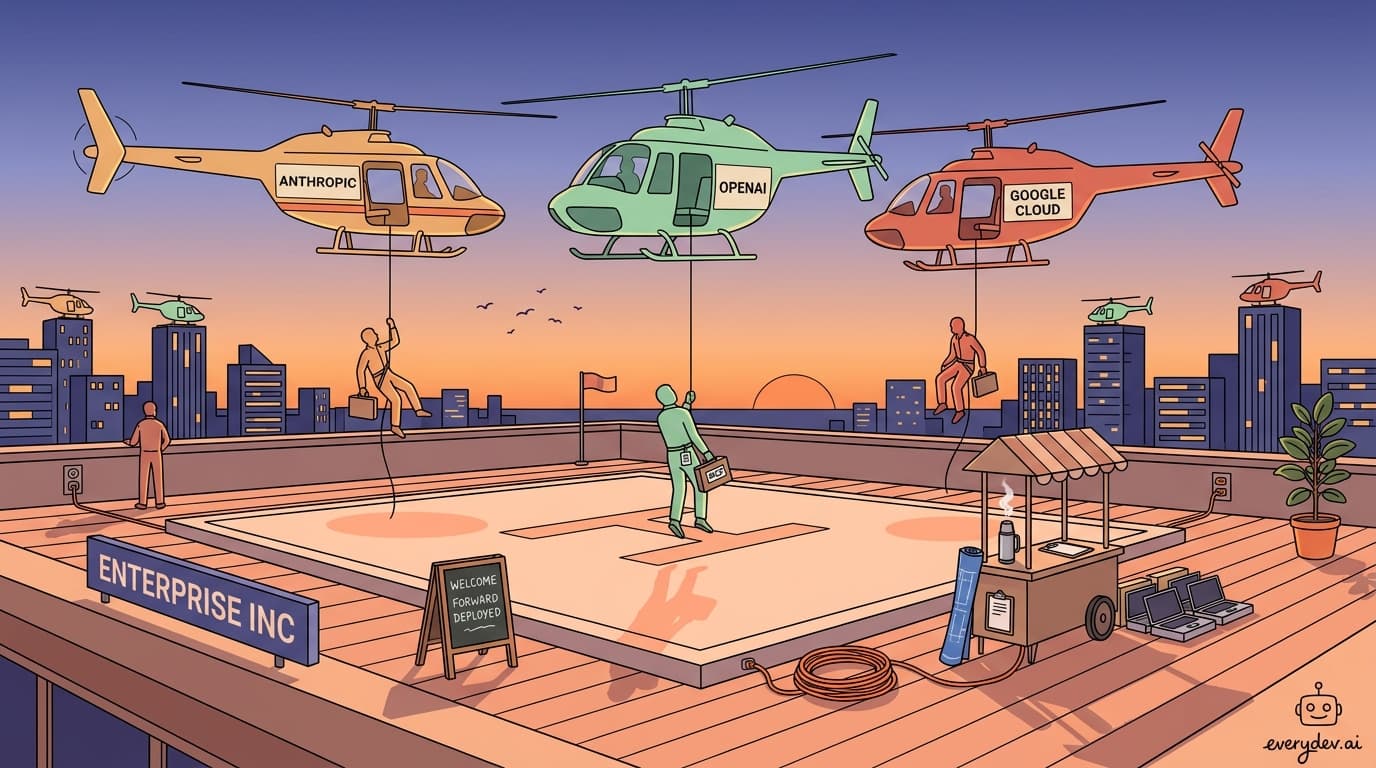
Google announced on May 12 that it will hire hundreds of Forward Deployed Engineers inside Google Cloud (The Information). Thomas Kurian, the unit's chief, posted the news on LinkedIn. Matt Renner, Google Cloud's chief revenue officer, framed the team in a separate post as helping Google "show up for our customers with more technical resources (vs just an ocean of salespeople)." With Anthropic's enterprise services JV announced May 4 (Anthropic) and the DeployCo/Tomoro acquisition closed May 11, three frontier labs converted FDE hiring into their primary enterprise-go-to-market motion inside two weeks.
Nader Dabit's mid-week post on X called the Forward Deployed Engineer "the hottest, and one of the most in-demand, jobs right now," and named OpenAI, Cognition, Anthropic, and Google as the active hirers (Nader Dabit). The job itself is the Palantir 2008 playbook: embed a strong engineer at the customer, build the production system, train the customer's team, then rotate out. What is new is that every frontier lab is now running it as a primary sales motion in the same quarter, and the candidate pool is the developer audience that has spent the past year worrying about being replaced.
The companies that pitched AI as the replacement for engineers are now hiring engineers as the service that makes the AI work. The model is the lead generator. The Forward Deployed Engineer is what closes the deal and keeps the customer building.
In Focus
The runtime layer
Hermes Agent overtook OpenClaw on OpenRouter daily token volume on May 10. Nous Research's open-source agent runtime hit 224B daily tokens against OpenClaw's 186B (OpenRouter rankings). First time OpenClaw has not held the top daily spot since its rise in late 2025. OpenClaw still leads cumulatively (9.17T all-time vs Hermes 6.35T) and on GitHub stars (370K+ vs 114K+), so this is a momentum flip rather than a coronation. Hermes v0.13.0 "Tenacity" shipped May 7 with 864 commits, 588 merged PRs, and a Kanban-style durable multi-agent task board with heartbeat monitoring and hallucination recovery. The design philosophies diverge: OpenClaw bets on platform reach (50+ messaging channels, 44K-skill ClawHub library); Hermes bets on agent depth (three-layer memory: persistent identity, SQLite FTS5 session history, procedural skill files the agent writes for itself). Hermes is winning daily token share with roughly 40% of OpenClaw's platform reach. MIT-licensed migration tool included.
| Tool | Daily tokens (May 10) | Cumulative | GitHub stars | Design bet |
|---|---|---|---|---|
| Hermes Agent | 224B | 6.35T | 114K+ | Agent depth (3-layer memory) |
| OpenClaw | 186B | 9.17T | 370K+ | Platform reach (50+ channels) |
Thinking Machines made its first major public product reveal on May 11. Mira Murati's lab released a research preview of interaction models, headlined by TML-Interaction-Small at 276B parameters. Full-duplex architecture: audio and video input streams in 200ms chunks, response generation runs in parallel rather than after the user finishes. Claimed 0.40 second response latency, faster than Gemini-3.1-flash-live on FD-bench. The model implicitly detects whether the speaker is thinking, yielding, self-correcting, or inviting a response, with no separate dialog manager. Reportedly in talks at ~$50B valuation. Meta tried to buy Thinking Machines in 2025, Murati declined, Meta hired seven founding members, Murati hired PyTorch creator Soumith Chintala as CTO in response.
Anthropic is reportedly in talks to acquire Stainless for over $300M (Digitimes). Stainless builds SDKs for AI companies including Google and OpenAI. If the deal closes, Anthropic ends up owning the canonical SDK toolchain its competitors use to ship their own client libraries. Anthropic also shipped Claude Code agent view on May 12 as a research preview, which manages multiple parallel Claude Code sessions from a single interface. No more separate terminal tabs per agent.
Google announced Magic Pointer and the Googlebook on May 12 at the Android Show: I/O Edition. Magic Pointer is a Gemini-powered cursor that captures visual and semantic context. Point at a date in an email to schedule a meeting, point at a recipe and ask to double it, select two images and ask to visualize them together. DeepMind's framing is to eliminate "AI detours" by bringing AI to where the user is. Two demos are live in Google AI Studio (image edit, map search), rolling out in Chrome (DeepMind). Googlebook is the Chromebook successor and the platform name for what looks very much like the long-rumored Aluminum OS: an OS combining the Android stack with ChromeOS. Hardware partners Acer, Asus, Dell, HP, Lenovo. Ships fall 2026 (Google). Premium positioning, no pricing yet, but Google's framing strongly suggests MacBook-class pricing rather than $179 Chromebook anchor.
GitLab announced an "open restructuring" on May 11 (The Register). Voluntary separation window opens May 11, deadline May 18, final org by June 1, specific cut numbers in Q1 FY2027 earnings on June 2. Estimated 7% cut. Structural moves: country footprint reduced up to 30%, up to three management layers removed, R&D reorganized into ~60 small autonomous teams. CEO Bill Staples insists "this is not an AI optimization or cost cutting exercise," but TNW and byteiota both note the playbook is identical to Atlassian's March 10% cut, with the same "self-fund AI" language. GitLab's Duo Agent Platform only hit GA in January 2026, late to a market where Cursor cleared $2B ARR by February. GTLB closed down 7–8% after hours, market cap now ~$4.1B, down from $15B at its 2021 peak. Meta employees protested mouse-tracking software at US offices on May 12 (Reuters), distributing flyers with the tagline "Don't want to work at the Employee Data Extraction Factory?" in meeting rooms, on vending machines, and on top of toilet paper dispensers. Andy Stone, Meta's spokesperson, gave Reuters the quote that says the quiet part: "If we're building agents to help people complete everyday tasks using computers, our models need real examples of how people actually use them, things like mouse movements, clicking buttons, and navigating dropdown menus." Roughly one week before Meta cuts 10% of its workforce. UK staff are unionizing through United Tech and Allied Workers.
Signals
Signals from the Edges
Python 3.15 hit feature freeze with its first beta released
Stable ABI for free-threaded CPython (extension authors no longer rebuild per minor version), an explicit lazy import keyword, a new Tachyon sampling profiler (near-zero overhead, sampling rates up to 1MHz), UTF-8 as default text encoding. JIT improvements: 8–9% mean on x86-64 Linux, 12–13% on Apple silicon. The incremental garbage collector from 3.14 was reverted after memory leak reports. Stable release October 1.
OpenAI began winding down its fine-tuning platform on May 7
New organizations are blocked from creating training jobs immediately. The full shutdown lands January 6, 2027. SFT is still available on gpt-4.1 variants and RL on o4-mini for existing customers in the interim, then nothing. OpenAI's recommended migration path is managed customization (prompts, structured outputs, evals, file search, agent SDK) instead of weight-level training. Fortune's critique stands: fine-tuning was where customers could own model behavior independent of vendor tooling.
Claude Code 2.1.137 shipped May 9
With the VS Code Windows extension activation fix. The 2.1.133→2.1.137 sequence May 8–9 also added worktree.baseRef control, Linux sandbox path settings, admin policy merge, and effort level exposed to hooks.
IBM survey: 76% of organizations now have a Chief AI Officer
Up from 26% in 2025. Companies with a CAIO report 20% higher AI ROI and 29% fewer losses from AI irregularities. 2,000 CEOs surveyed across 33 geographies.
Tokenized PreStocks for Anthropic and OpenAI fell 38% and 46%
on CoinGecko after both companies issued notices that unauthorized equity transfers may be void. Anthropic specifically named Open Door Partners, Hiive, and Forge as unauthorized.
JPMorgan initiated Mistral coverage on May 13,
calling it Europe's most valuable AI company with a $430B addressable market by 2030.
DeepMind's AI co-mathematician paper hit 48% on FrontierMath Tier 4
against the previous best of ~19%. Oxford topologist Marc Lackenby used the system to close a 60-year-old problem from the Kourovka Notebook.
Anthropic shipped an audiobook version of Claude's Constitution on May 11,
narrated by Amanda Askell and Joe Carlsmith with commentary on the philosophy and development behind it. Weekend listening if you need it.
Digg returned as an AI news aggregator on May 11
Kevin Rose, AI-only at launch. Beta is buggy.
Looking Ahead
What to Watch
- 1
[Google I/O main event May 19-20](/p/dev-google-io-is-next-week-may-1920)
Shoreline Amphitheater. The Android Show on May 12 was the warm-up. Expect more Gemini model news, Aluminum OS specifics, possible Android XR glasses preview, and developer-facing Magic Pointer demos.
- 2
GitLab's Q1 FY2027 earnings June 2
Actual cut numbers and the post-restructuring org chart land here. If revenue guidance holds, the "self-fund AI" framing survives. If not, GTLB joins the Cloudflare narrative.
- 3
Codex's free 30-day switch window expires mid-June
This is the cleanest experiment of the year for measuring vendor stickiness. If Codex retains a meaningful share of switchers past the window, the Claude Code position weakens.
- 4
OpenAI fine-tuning full shutdown January 6, 2027
Eight months to migrate any production workload that depends on owned weights. Plan now if you have not already.
- 5
Notion Workers free beta ends August 11
The credit-model pricing will set the ceiling on how much of an orchestration story Notion can credibly tell to enterprise buyers.
The agent stack is consolidating around three or four companies, and the compute funnel is consolidating around one. Notion's neutral-ground play and Hermes overtaking OpenClaw on daily volume are the bets that the lock-in is reversible. The TanStack worm is a reminder that lock-in is not the only thing getting harder to unwind.